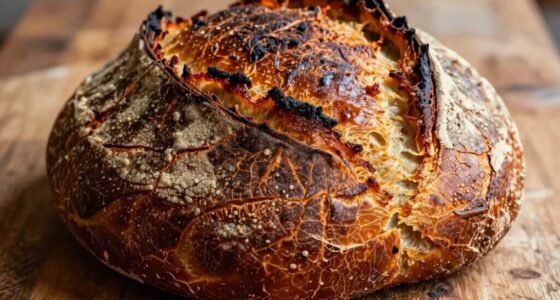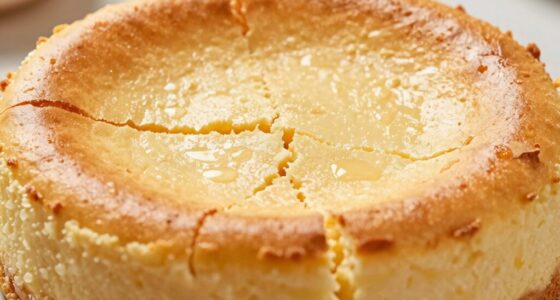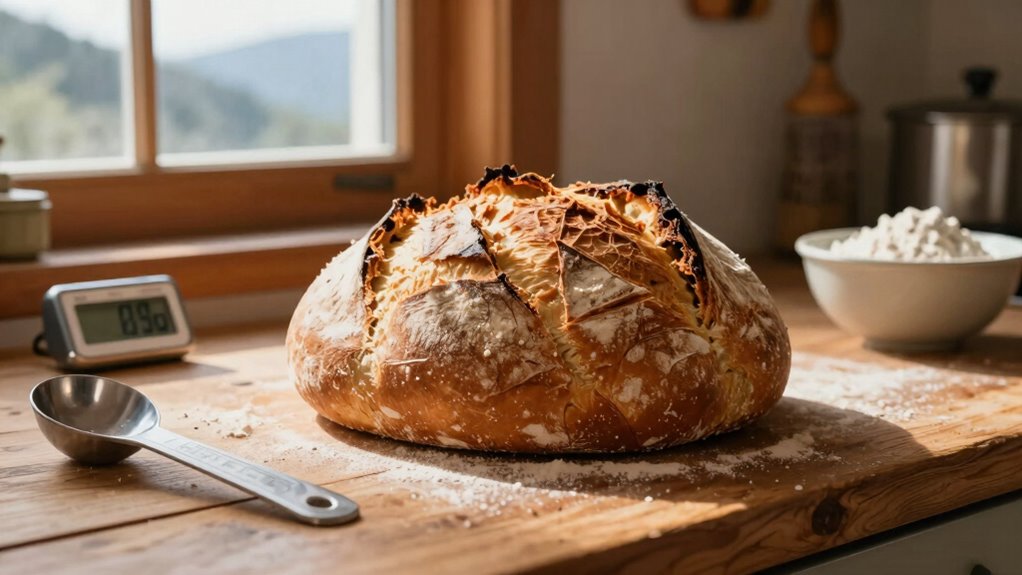
At high altitudes, you should adjust your baking by reducing liquids and leavening agents since liquids evaporate faster and gases expand more. You might also need to increase your flour or hydration to strengthen dough structure. Shortening baking times and adding a pinch of extra salt or flavorings can improve taste. Small tweaks make a big difference, and if you want more tips, you’ll find practical solutions that turn altitude challenges into success.

Get kitchen gear delivered free — and shop member deals
- Fast, free delivery on millions of items
- Access to Prime Big Deal Days deals on October 6–7
- Prime Video, Amazon Music and more included
Key Takeaways
- Reduce leavening agents slightly to prevent over-expansion and collapsing of baked goods.
- Adjust baking times and temperatures to account for faster evaporation and heat transfer.
- Increase liquid or hydration in recipes to maintain dough elasticity and structure.
- Incorporate subtle flavor enhancements like extra vanilla or salt to counteract flavor concentration.
- Keep detailed notes and experiment gradually to fine-tune recipes for consistent high-altitude results.
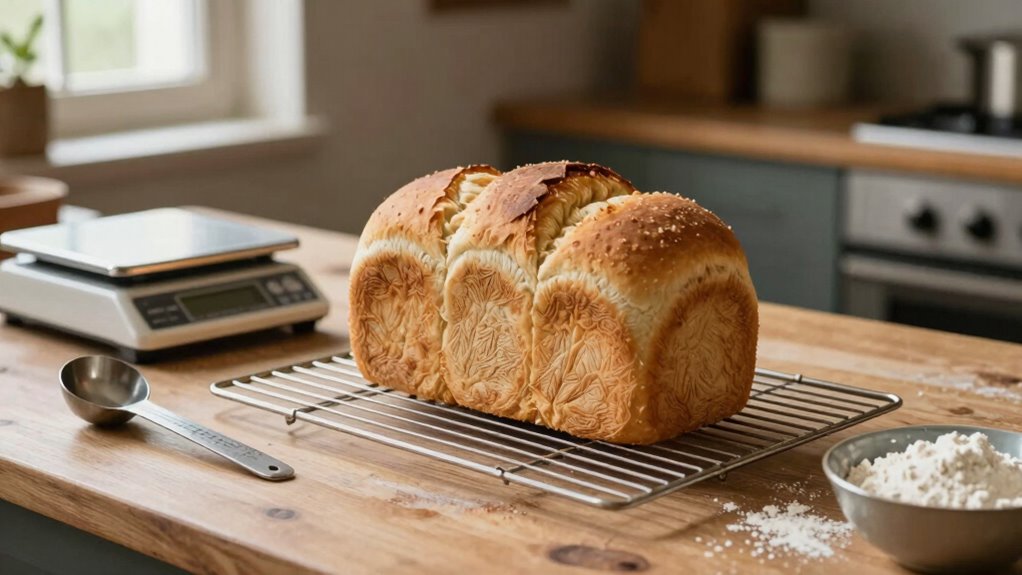
Ever wondered why your baked goods sometimes turn out differently at high altitudes? The answer lies in the way altitude affects baking conditions, particularly how dough elasticity and flavor enhancement come into play. At higher elevations, the lower air pressure causes liquids to evaporate faster and gases to expand more quickly. This means your recipes often need some adjustments to turn out just right. Recognizing these subtle changes can make a significant difference in your baking success.
High altitudes alter baking by speeding evaporation and gas expansion, requiring recipe adjustments for perfect results.
One of the main challenges at altitude is controlling dough elasticity. When you mix your batter or dough, the reduced air pressure causes the gluten to stretch more easily, which can lead to over-expansion and collapsing during baking. To counter this, you might want to slightly decrease the amount of leavening agents like baking powder or baking soda. This helps regulate how much your dough expands, maintaining its structure. Additionally, tweaking the kneading process can improve dough elasticity, making it more resilient and less prone to over-expanding. Incorporating ingredients like a bit more flour or adjusting hydration levels can also provide the right balance, ensuring your dough maintains its shape and texture when baked. Paying attention to atmospheric conditions can help you make more precise adjustments for consistent results.
Flavor enhancement is another key aspect affected by altitude. Because liquids evaporate faster, flavors can become more concentrated or muted depending on how you adjust your recipes. To amplify flavor at high altitude, consider slightly increasing the amount of vanilla, spices, or other flavoring agents. This compensates for the quicker evaporation and ensures your baked goods taste as rich and vibrant as intended. Also, adding a pinch more salt can intensify overall flavor, making each bite more satisfying. These small tweaks can make a noticeable difference, helping your baked goods retain their intended flavor profile despite the environmental changes. Understanding how dough elasticity and flavor interact at altitude can help you fine-tune your recipes more effectively.
Finally, remember that altitude baking often calls for a bit of trial and error. Keeping detailed notes on your adjustments allows you to refine your process over time. Start by making small changes to ingredients and baking times, and observe how your baked goods respond. With patience and practice, you’ll develop a reliable approach tailored to your specific elevation. Understanding how altitude influences flour and liquids and flavor enhancement empowers you to adapt your recipes confidently, turning high-altitude baking into a straightforward, enjoyable process.
high altitude baking leavening agents
As an affiliate, we earn on qualifying purchases.
As an affiliate, we earn on qualifying purchases.
Frequently Asked Questions
How Does Altitude Affect Yeast Fermentation Times?
At higher altitudes, your yeast fermentation times increase because the lower air pressure slows down the fermentation process. Humidity effects also play a role, as drier air can cause dough to dry out faster, further affecting fermentation speed. To compensate, you might need to increase the yeast amount or extend proofing times. Adjusting your recipe for altitude guarantees your baked goods rise properly and maintain the desired texture.
Can I Use Standard Recipes at High Altitude Without Changes?
Sure, you can try using standard recipes at high altitude, but don’t be surprised if sugar crystallization happens faster and flour absorption shifts unexpectedly. Irony? Your batter might rise too quickly or not enough, despite following the same instructions. Without tweaking ingredients for altitude, you risk inconsistent results. So, embrace the adventure, but be ready to adjust—your baked goods will thank you for the altitude-aware tweaks.
What Ingredients Are Most Impacted by Altitude Adjustments?
You’ll find that ingredients like baking powder, sugar, and liquids are most impacted by altitude adjustments. You might need ingredient substitutions, such as reducing baking powder or increasing liquids, to prevent over-rising or dry textures. Additionally, consider flavor enhancements like adding a pinch of salt or vanilla to balance the altered batter. These tweaks help guarantee your baked goods turn out perfectly, even at high altitudes.
How Do I Prevent My Baked Goods From Collapsing at High Altitude?
Think of your baked goods as delicate balloons—at high altitude, they’re prone to collapsing. To prevent this, you should tweak your recipe with sweet substitutions like reducing sugar, which stabilizes structure. Moisture management is key too; add a touch more liquid to keep batter moist and resilient. These simple adjustments help your baked creations stay firm and fluffy, like clouds untouched by mountain winds.
Are There Specific Tools Recommended for Altitude Baking?
You should use specific tools like a reliable oven thermometer to guarantee proper oven calibration, which is vital at high altitudes. Additionally, employing precise kneading techniques helps develop gluten structure, preventing collapse. Invest in a good set of measuring cups and spoons to maintain accurate ingredient ratios. These tools help you adapt your baking process, making certain of consistent results despite altitude challenges. Proper calibration and technique are key to successful altitude baking.
altitude baking adjustment tools
As an affiliate, we earn on qualifying purchases.
As an affiliate, we earn on qualifying purchases.
Conclusion
So, there you have it—your foolproof guide to conquering altitude baking. Just remember, when your cake defies gravity—or your patience—tweaking those simple fixes can save the day. After all, who needs a bakery degree when you’ve got a pinch of humor and a dash of perseverance? Happy baking, and may your creations rise perfectly, even if the mountain air isn’t exactly conducive to good cheer. Cheers to altitude mastery!
baking measuring cups and spoons
As an affiliate, we earn on qualifying purchases.
As an affiliate, we earn on qualifying purchases.
As an affiliate, we earn on qualifying purchases.
Fall Picks
fall essentials
As an affiliate, we earn on qualifying purchases.