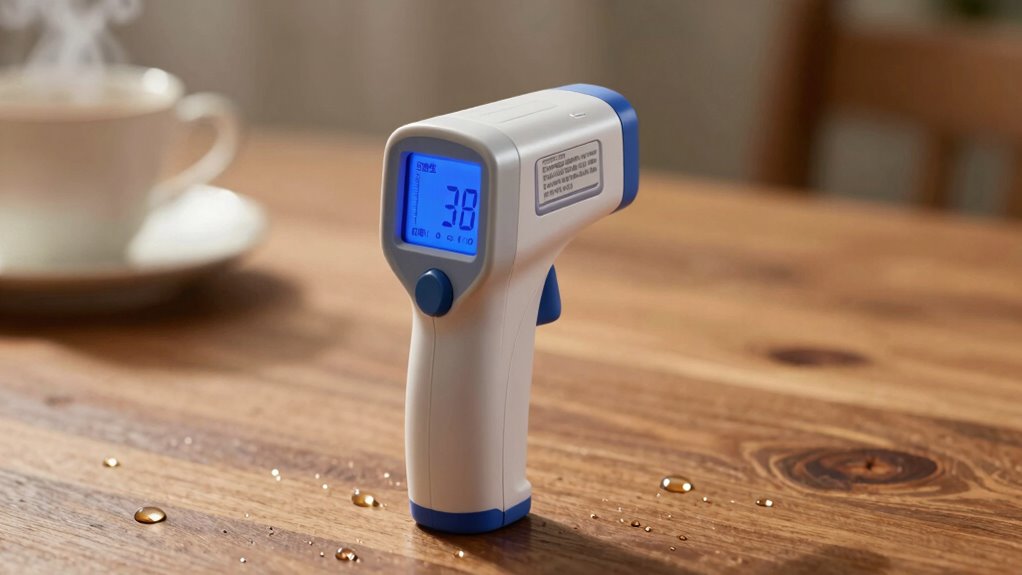

Infrared thermometers are great for quick temperature checks, but they can’t tell you everything. They measure infrared radiation and their accuracy can be affected by surface texture, reflective materials, or dirt. If the object’s emissivity isn’t taken into account, you might get misleading results. Also, the distance from which you measure matters, as being too far can lead to inaccurate readings. Want to guarantee you’re getting the best results? There’s more to evaluate.

Get kitchen gear delivered free with Prime
- Fast, free delivery on millions of items
- Prime Video, Amazon Music and more included
- Member-only deals all year
Key Takeaways
- Infrared thermometers cannot provide accurate readings on shiny or transparent surfaces due to reflection interference.
- They may misinterpret temperatures if the surface emissivity is not accounted for or adjusted.
- Immediate temperature readings do not guarantee accuracy, especially in variable environmental conditions.
- Measurement distance affects accuracy; being too far can incorporate heat from nearby objects.
- Users should be aware that dirty surfaces can significantly skew temperature results.

Infrared thermometers are crucial tools that let you measure temperature quickly and accurately without direct contact. They’re especially useful in various settings, from food safety to industrial applications. However, while they offer convenience, there are important factors you need to understand to guarantee you’re getting accurate readings.
One major aspect to evaluate is temperature accuracy. Though infrared thermometers can provide immediate readings, their accuracy isn’t always assured. They measure the infrared radiation emitted by an object, translating that into a temperature reading. If you’re not aware of the specific conditions affecting the reading, you might misinterpret the data. For example, if the surface of the object is dirty, reflective, or has a different texture, it can skew the results.
You’ll also need to pay attention to surface limitations. Infrared thermometers work best on certain types of surfaces. Smooth, matte surfaces generally yield better results than shiny or transparent ones. If you’re measuring temperature on a shiny metal or a glass surface, the readings might not reflect the true temperature. This is because the thermometer can misinterpret the emitted radiation due to reflection. That’s why you should familiarize yourself with the surfaces you’re measuring.
Another significant factor is object emissivity, which refers to how effectively a surface emits infrared radiation. Different materials have different emissivity values, affecting readings. For instance, a black surface has a higher emissivity than a shiny one. If you don’t adjust for emissivity, the thermometer may give you an inaccurate temperature. Some infrared thermometers allow you to set the emissivity value, but many don’t. So, if you’re using a thermometer without this feature, be cautious and remember that readings can vary based on the object’s material.
Lastly, measurement distance plays an essential role in obtaining accurate readings. Each infrared thermometer has a specific distance-to-spot ratio, which determines how far away you can stand while still getting accurate measurements. If you’re too far away, the reading might include heat from surrounding objects, leading to inaccuracies. Always check the manufacturer’s guidelines on the ideal measurement distance for your device.
Understanding these limitations guarantees you get the most accurate temperature readings, helping you make informed decisions based on the data you collect.
infrared thermometer with emissivity adjustment
As an affiliate, we earn on qualifying purchases.
As an affiliate, we earn on qualifying purchases.
Frequently Asked Questions
Can Infrared Thermometers Measure Internal Body Temperature Accurately?
No, infrared thermometers can’t measure internal body temperature accurately. They primarily capture surface temperatures, which means their measurement limitations can lead to misleading results. For true internal temperature accuracy, you’d need more invasive methods like oral or rectal thermometers. While infrared thermometers are quick and convenient, they shouldn’t replace traditional methods when precise internal readings are essential. Always consider the context and situation before relying solely on infrared measurements.
How Do Environmental Factors Affect Infrared Temperature Readings?
Environmental factors can greatly influence infrared temperature readings. When you measure in areas with varying ambient temperatures or reflective surfaces, your results might not be as accurate as you’d hope. Humidity levels can also play a role, affecting how heat is emitted and absorbed. Additionally, distance factors matter; the farther away you are from the target, the more potential for error in your reading. Staying mindful of these elements guarantees more reliable measurements.
Are There Specific Models Best for Home Use?
Yes, there are specific models great for home use. Look for infrared thermometers with a wide temperature range, ideally from -58°F to 1022°F, to cover various needs. For home safety, choose a model that features a laser guide for accuracy and a built-in memory function to track temperature changes. Brands like Etekcity and Fluke offer reliable options that make monitoring safe and easy, ensuring you stay informed about your home’s temperature conditions.
Do Infrared Thermometers Work on All Skin Tones?
Infrared thermometers can work on various skin tones, but skin pigmentation might affect measurement accuracy. Darker skin can absorb and emit heat differently, which may lead to variations in temperature readings. To guarantee you get the most accurate results, you should follow the manufacturer’s guidelines and consider factors like ambient temperature and distance. It’s best to use these devices as a general screening tool rather than relying solely on them for precise measurements.
What Maintenance Do Infrared Thermometers Require for Accuracy?
To keep your infrared thermometer accurate, you need to calibrate it regularly—typically every six months or after significant temperature shifts. Don’t forget about sensor cleaning, either; dust and debris can affect readings. Gently wipe the sensor with a soft cloth to avoid damage. By following these maintenance tips, you’ll guarantee your thermometer delivers reliable results when you need them most. Regular care helps prolong its lifespan and accuracy.
non-reflective surface infrared thermometer
As an affiliate, we earn on qualifying purchases.
As an affiliate, we earn on qualifying purchases.
Conclusion
While infrared thermometers offer quick temperature readings, they can’t reveal everything about your subject. They miss underlying issues like surface conditions and emissivity variations. You might think you’ve got the full picture, but the truth is more complex. Always combine these readings with other methods for a complete understanding. So, next time you rely on one, remember: it’s just one tool in your toolkit, not the entire solution. Embrace the nuances for a more accurate assessment.
infrared thermometer for food safety
As an affiliate, we earn on qualifying purchases.
As an affiliate, we earn on qualifying purchases.
industrial infrared temperature gun
As an affiliate, we earn on qualifying purchases.
As an affiliate, we earn on qualifying purchases.
Halloween Picks
halloween
As an affiliate, we earn on qualifying purchases.