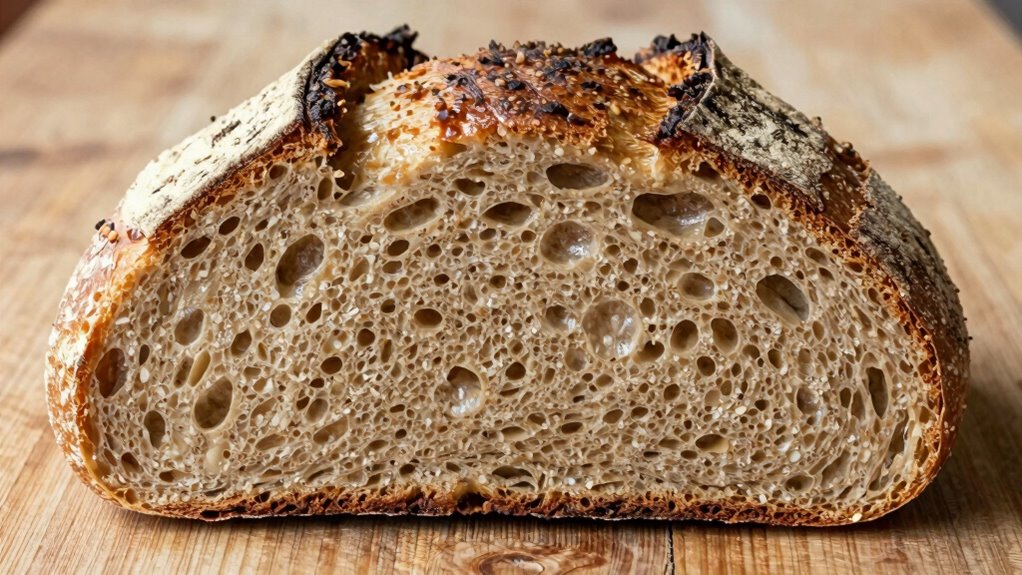

If your whole wheat bread feels dense, it’s likely due to uneven or insufficient hydration. Whole wheat flour absorbs more water, so you need to adjust your mix to keep the dough slightly tacky but not sticky. Proper hydration helps develop a strong, elastic gluten network, trapping gas and ensuring a light crumb. When hydration is just right, fermentation improves, giving your bread a better rise and texture. Keep exploring for more tips on perfecting your loaf.

Get kitchen gear delivered free with Prime
- Fast, free delivery on millions of items
- Prime Video, Amazon Music and more included
- Member-only deals all year
Key Takeaways
- Insufficient hydration weakens gluten development, resulting in a denser, less airy crumb in whole wheat bread.
- Proper hydration ensures the dough is tacky, promoting better gluten formation and lighter texture.
- Under-hydrated dough slows fermentation, limiting gas production and causing a dense loaf.
- Whole wheat flour absorbs more water; inadequate hydration leaves the bran dry and obstructs gluten networks.
- Adjusting hydration levels based on flour and environment helps achieve a lighter, more open crumb in whole wheat baking.
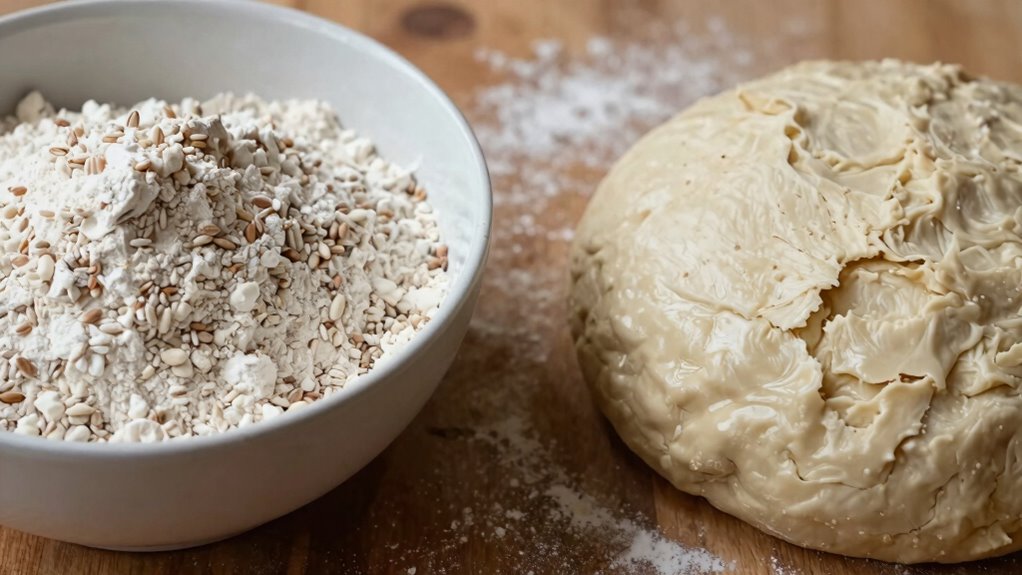
Ever wonder why recipes for whole wheat bread sometimes turn out denser or drier than expected? The main culprit often comes down to hydration levels, which directly influence gluten development and fermentation timing. Whole wheat flour absorbs more water than white flour, but it also contains the bran and germ that can interfere with gluten formation if not properly hydrated. If your dough isn’t sufficiently hydrated, gluten won’t develop fully, leading to a tighter, denser crumb. Conversely, too little water prevents the dough from relaxing and expanding properly during fermentation, resulting in a compact loaf.
Getting the hydration right is essential because it impacts gluten development. When you add enough water, the gluten proteins in the flour form a strong, elastic network that traps gas produced during fermentation. This network allows the dough to rise effectively, giving your bread a lighter, airier texture. Without proper hydration, gluten strands remain weak, and the dough won’t hold the gas well, causing the bread to be dense. Additionally, hydration affects fermentation timing. Properly hydrated dough ferments at a steady rate, allowing yeast to produce enough carbon dioxide for good rise. If the dough is too dry, fermentation slows down, and the dough may not develop enough lift, leading to a flatter, denser loaf. Proper hydration also promotes enzyme activity, which helps break down some of the bran and makes nutrients more accessible, further benefiting gluten formation and yeast activity. Maintaining consistent hydration levels can be challenging but is crucial for reproducible results.
Proper hydration strengthens gluten and ensures steady fermentation for a lighter, airy whole wheat loaf.
Adjusting hydration isn’t just about adding more water blindly. You need to observe how your dough feels and behaves. Whole wheat flour can vary in absorbency, so you might need to tweak the water amount based on humidity and flour brand. A good rule of thumb is to aim for a dough that’s slightly tacky but not sticky. This ensures that gluten can develop properly and fermentation can proceed at an ideal pace. Keep in mind that a well-hydrated dough also promotes better enzyme activity, breaking down some of the bran and making nutrients more accessible, which further benefits gluten formation and yeast activity.
Timing your fermentation is just as important. If your dough is too dry, it might need a longer fermentation period to develop flavor and rise. Conversely, a properly hydrated dough ferments more predictably, resulting in a better rise and a lighter crumb. Pay attention to how the dough behaves during bulk fermentation; it should roughly double in size and feel elastic. If it’s sluggish, consider increasing hydration slightly or adjusting fermentation time. Finding the right hydration level for your specific flour and environment is key to achieving that perfect, airy whole wheat loaf without the unwanted density or dryness.
Products Worth Considering

Cuisinart 6-Quart Basket Air Fryer with Viewing Window, Stainless Steel and Black (AIR-200NAS)

Cuisinart Stainless Steel Bread Maker, 12 Programs, 2 lb Capacity

Le Creuset Enameled Cast Iron Round Dutch Oven, 5.5 Qt, Flame
As an affiliate, we earn on qualifying purchases.
Frequently Asked Questions
How Do I Know if My Dough Needs More Water?
If your dough feels stiff or lacks elasticity, it probably needs more water. When you add moisture, it helps with dough elasticity and improves moisture retention, making the dough softer and easier to handle. To check, pinch a small piece and stretch it gently; if it tears easily, add a little water gradually. Keep observing its texture until it becomes smooth, pliable, and slightly sticky, indicating ideal hydration.
Can I Substitute Other Flours for Whole Wheat?
Can you substitute other flours for whole wheat? Absolutely, but keep in mind that different flours, like all-purpose or spelt, have unique protein contents affecting gluten development. To guarantee your bread turns out well, consider using alternative flour blends that mimic whole wheat’s texture and hydration needs. Adjust hydration levels accordingly, as some flours absorb more water, impacting gluten development and the final density of your baked goods.
Does Hydration Level Affect Bread Flavor?
Yes, hydration level impacts bread flavor by influencing flavor development and hydration consistency. When you adjust hydration, you alter how ingredients interact, affecting fermentation and the resulting taste. Higher hydration can enhance complex flavors, while lower hydration might produce a milder profile. You should experiment with hydration levels to find the balance that delivers both the desired texture and flavor, ensuring consistency in your baking process.
How Long Should I Let the Dough Rest After Hydration?
You should let your dough rest for at least 20-30 minutes after hydration—this is the magic window where dough transforms into a stretchy, elastic marvel. During this time, gluten develops rapidly, boosting dough elasticity and making it easier to shape. Skipping or shortening this rest period can result in a dense, tough loaf. So, patience now results in a beautifully airy, well-developed bread later!
Are There Specific Hydration Ratios for Different Whole Wheat Types?
Yes, hydration ratios vary depending on the grain maturity and milling process. For more mature grains, which have a higher protein and fiber content, you might need slightly more water to achieve ideal hydration. Less mature grains, processed with finer milling, absorb less water. Adjust your hydration based on the specific whole wheat type, and experiment to find the perfect balance for your dough’s texture and rise.
Conclusion
Remember, adjusting hydration when working with whole wheat isn’t just a tip—it’s the secret ingredient to perfect bread. Think of it as tuning a finely crafted instrument; too little water, and it’s dull and dense, too much, and it’s a soggy mess. Trust your instincts, observe your dough’s texture, and you’ll discover the magic of light, airy whole wheat bread. After all, mastery is found in the details—hydration being the key to your baking triumph.