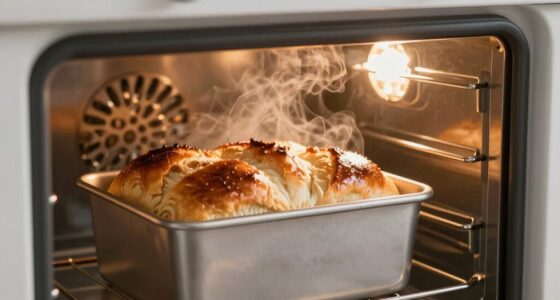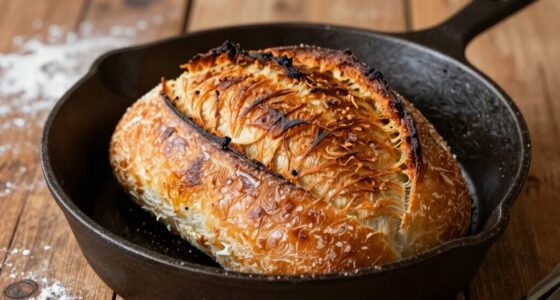
When your bread splits on the side, it’s often caused by uneven crust expansion or improper scoring. If the dough isn’t proofed enough, the gluten stays tight, leading to unpredictable tears. Cutting the right scoring lines guides the crust to split cleanly, while skipping or poorly scoring can cause uncontrolled cracks. Too rapid crust formation from high oven temperatures can also force the bread to split incorrectly. Keep these factors in mind to improve your bread’s look and shape—more details await.

Get kitchen gear delivered free with Prime
- Fast, free delivery on millions of items
- Prime Video, Amazon Music and more included
- Member-only deals all year
Key Takeaways
- Side splits occur when crust expands unevenly due to improper scoring or excessive crust pressure.
- Proper scoring creates controlled weak points, guiding the bread to split along desired lines.
- Insufficient or incorrect scoring can cause unpredictable side splits during baking.
- Under-proofed dough is too tight, leading to uneven or restricted expansion that causes side splits.
- Over-proofed dough weakens the gluten structure, resulting in irregular or unintended splits on the sides.
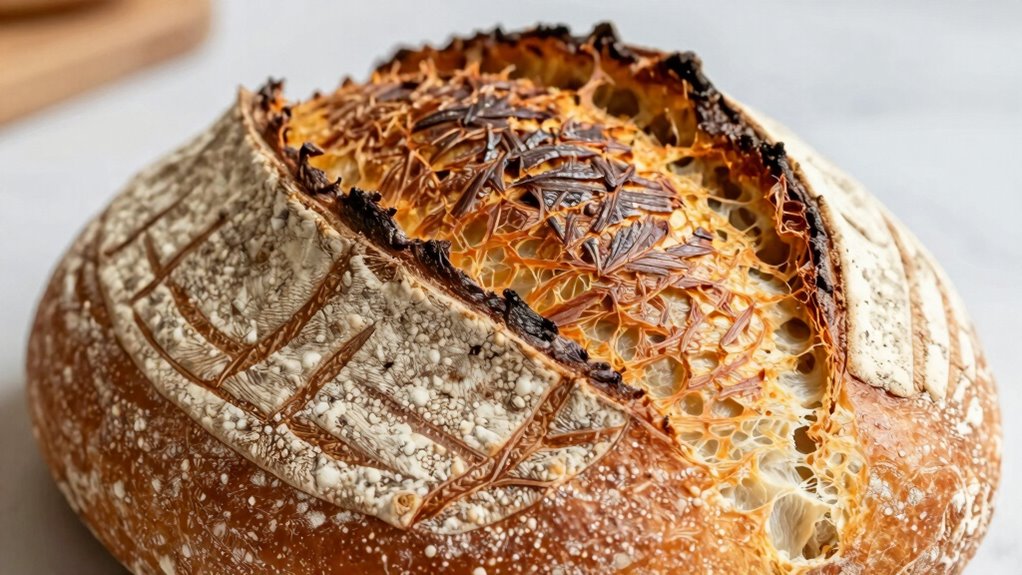
Have you ever noticed bread splitting on the side instead of tearing evenly? It’s a common baking mystery, and understanding why it happens can help you get better results every time. One key factor is crust expansion, which occurs during baking. When you place bread in the oven, the heat causes the dough to expand, and the crust begins to form. If the crust expands unevenly or too quickly, it can cause the loaf to split on the side instead of splitting naturally along the score lines you made beforehand.
Uneven crust expansion during baking can cause side splits instead of clean, natural tears along your score lines.
Oven temperature plays a significant role in how the crust develops and how the bread behaves during baking. If the oven is too hot, the crust can set too rapidly, preventing the bread from expanding evenly. This rapid crust formation creates pressure inside the loaf, often forcing it to split on the side where the crust is weakest. Conversely, if your oven temperature is too low, the bread might not develop a strong crust at all, leading to inadequate crust expansion and an uneven split or none at all.
This is where scoring becomes essential. When you score your dough, you create controlled weak points that guide where the bread will split during baking. Proper scoring allows the crust to expand in a controlled manner, reducing the chance of side splits caused by crust expansion. However, if the dough isn’t proofed properly—meaning it hasn’t developed enough gluten structure—the bread won’t hold its shape well, and uneven splits become more likely. Over-proofed dough, on the other hand, can collapse or create irregular splits because the gluten network has broken down.
To prevent side splits, focus on controlling your oven temperature and pay attention to your proofing process. Use a thermometer to ensure your oven hits the right temperature—typically around 450°F (232°C) for many bread types—and bake with steam if possible. Steam keeps the crust softer in the early stages, allowing for better crust expansion and a more even split. Also, make sure your dough is proofed just right: not under-proofed, which can cause tight, uneven splits, and not over-proofed, which can weaken the gluten structure. Additionally, understanding the crust expansion process can help bakers anticipate how the loaf will split and adjust their techniques accordingly. Recognizing how gluten development influences dough strength is vital to achieving a well-structured loaf that splits evenly.
In fact, paying attention to both oven conditions and dough maturity can significantly improve your baking outcomes. When these elements work together, your bread can rise and split beautifully along the intended lines, giving you that perfect, artisan look every baker aims for.
Products Worth Considering

Le Creuset Enameled Cast Iron Round Dutch Oven, 5.5 Qt, Flame

Le Creuset Enamemed Cast Iron Oval Dutch Oven, 5 qt., White/Crucible

Le Creuset Signature Enameled Cast Iron Round Dutch Oven, 5.5 qt, Deep Teal
As an affiliate, we earn on qualifying purchases.
Frequently Asked Questions
Can Scoring Affect the Bread’s Crust Texture?
Scoring can definitely affect the bread’s crust texture. When you score your loaf, it guides crust development, allowing steam to escape and preventing uncontrolled splitting. This results in a crust with better resilience and a more even, desirable texture. Proper scoring helps you control how the crust forms, making it less prone to cracking unpredictably and improving the overall crust resilience, giving your bread a professional finish.
Is There a Preferred Scoring Pattern for Different Bread Types?
Think of scoring patterns as a baker’s signature, each one telling a story. For rustic boules, simple slashes work well, while intricate artistic patterns elevate sourdough loaves. Cultural variations influence the preferred designs, like the cross on Italian pane or decorative cuts on French baguettes. Choose your pattern based on bread type and tradition, knowing that each style enhances not only appearance but also how the bread bakes and releases steam.
How Does Oven Temperature Influence the Split?
Oven heat considerably influences the split by affecting crust development. Higher temperatures create a rapid oven heat, causing the bread to expand quickly and encouraging a clean split along the scored lines. Conversely, lower temperatures result in softer crusts, which may not split as neatly. To control how your bread splits, adjust the oven heat to optimize crust development—aim for a balance that promotes a crisp crust and a clean, attractive split.
Can Improper Proofing Cause Uneven Splits?
Yes, improper proofing can cause uneven splits. If you don’t follow proper fermentation timing, the dough might not develop enough strength, making it prone to uneven expansion. Over-proofed dough can be too weak, causing irregular splits, while under-proofed dough might not expand properly. Your kneading techniques also matter—insufficient kneading can lead to inconsistent gluten development, which affects how the bread expands and splits during baking.
Does the Type of Flour Impact Where the Bread Splits?
Yes, the type of flour impacts where your bread splits. Flour consistency influences dough elasticity, which affects how the bread expands during baking. Higher protein flours create more elastic dough, directing splits along weaker spots, often on the sides. Lower protein flours result in less elastic dough, leading to uneven splits or cracks. Choosing the right flour and maintaining consistent dough elasticity helps control where your bread splits.
Conclusion
So, next time your bread reveals a gentle crack on the side, remember it’s just a quiet whisper of your baking journey—an understated signature of your craft. Whether it’s scoring or proofing, these subtle signs remind you that perfection isn’t always about flawlessness, but about embracing the delicate dance of process and patience. In those tender splits, there’s a story of effort and hope, quietly whispering that your bread has truly come to life.