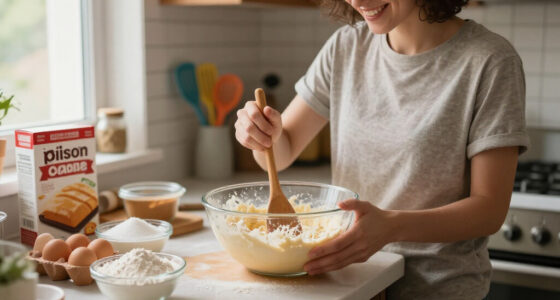
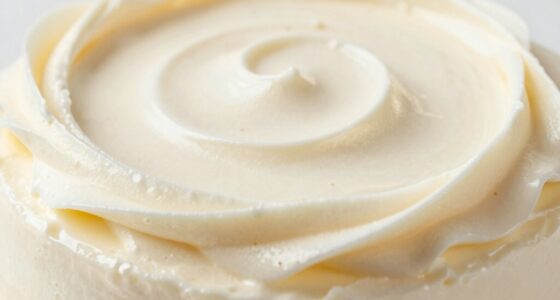
If your meringue weeps, it’s likely because you added sugar too early or too late in the process. Adding sugar before reaching soft peaks can cause graininess and weaken the foam, while adding it too late can lead to deflation and cracking. For the best stability and shine, incorporate sugar after soft peaks form but before reaching stiff peaks. Mastering the timing can make a real difference—keep going to discover how precise sugar timing transforms your meringue.

Get kitchen gear delivered free with Prime
- Fast, free delivery on millions of items
- Prime Video, Amazon Music and more included
- Member-only deals all year
Key Takeaways
- Adding sugar too early can interfere with foam formation, leading to weeping and instability.
- Late sugar addition prevents proper dissolution, weakening the meringue’s structure and causing weeping.
- Proper timing ensures sugar coats proteins, creating a stable network that resists moisture leakage.
- Incorrect sugar timing disrupts foam stability, resulting in a dense, watery, or weepy meringue.
- Adding sugar after soft peaks helps trap air and maintain moisture, preventing weeping and collapse.

Timing your sugar addition is crucial to achieving the perfect meringue. When you add sugar at just the right moment, you help create sweet stability, which guarantees your meringue holds its shape and doesn’t collapse or weep. If you add sugar too early, it can interfere with the formation of the foam, preventing the egg whites from reaching their full volume. Conversely, waiting too long to incorporate sugar can make it difficult to achieve the desired texture transformation, resulting in a dense or grainy meringue.
The key is to add sugar gradually once your egg whites have already reached soft peaks. This allows the sugar to dissolve evenly, reinforcing the foam without destabilizing it. When sugar dissolves properly, it coats the proteins in the egg whites, forming a stable network that traps air and creates a light, airy texture. This process is essential for giving your meringue that glossy finish and firm structure. By timing the sugar addition correctly, you promote sweet stability, which is the foundation of a durable and shiny meringue.
The texture transformation that occurs during sugar incorporation is subtle but critical. When you add sugar too early, you risk creating a grainy or stiff mixture because the sugar doesn’t dissolve fully, leading to an uneven structure. On the other hand, if you add sugar too late, the foam might start to deflate or crack, losing its volume and gloss. When you add sugar steadily after soft peaks, it dissolves smoothly, and the meringue starts to firm up and develop that characteristic sheen. This careful timing ensures you get a silky, smooth texture without compromising stability. Proper sugar timing is essential for a perfect meringue. Additionally, understanding the foam stability can help prevent common issues like weeping or collapse. Recognizing the importance of sugar dissolution can further improve your technique and final results. Being mindful of sugar incorporation can help you achieve the ideal texture and appearance every time. A deeper understanding of baking science can also assist in troubleshooting and refining your meringue-making skills.
stainless steel mixing bowls for baking
As an affiliate, we earn on qualifying purchases.
As an affiliate, we earn on qualifying purchases.
Frequently Asked Questions
Can Using Different Types of Sugar Affect Meringue Stability?
Yes, using different types of sugar affects meringue stability. For example, superfine sugar dissolves quickly, reducing sugar crystallization and creating a more stable, glossy meringue. Granulated sugar may cause more crystallization, leading to weeping. Additionally, some sugars enhance flavor, like powdered sugar adding sweetness and smoothness. Selecting the right sugar type guarantees your meringue stays firm, glossy, and flavorful without weeping or collapsing.
How Does Humidity Influence Sugar Timing in Meringue?
Humidity impact plays a significant role in sugar timing when making meringue. High humidity can cause moisture to be absorbed into the sugar, delaying proper crystallization and making your meringue more prone to weeping. You should be mindful of humidity levels to prevent sugar from crystallizing prematurely. Using dry, stable environments helps guarantee the sugar dissolves correctly and stabilizes the meringue, giving you that perfect, glossy finish.
Is There a Preferred Temperature for Adding Sugar?
Think of temperature control as your secret weapon—adding sugar at around 60°F (15°C) helps prevent sugar crystallization and guarantees a stable meringue. Too warm, and the sugar dissolves unevenly; too cold, and it risks recrystallization. You want a balanced environment where sugar integrates smoothly into the egg whites, creating that glossy, firm peak. Mastering this temperature keeps your meringue stable, light, and perfect every time.
Can Alternative Sweeteners Be Used Instead of Sugar?
You can use natural sweeteners or artificial sugars instead of regular sugar in your meringue, but results may vary. Natural sweeteners like honey or maple syrup can alter the texture and stability, making it harder to achieve stiff peaks. Artificial sugars, such as sucralose, might not provide the same structure or volume. Experiment carefully, and remember that traditional sugar usually gives the best, most stable meringue.
How Do I Fix Weeping Meringue After It’s Baked?
Your weeping meringue is like a teary-eyed dancer—fix it by stabilizing the foam. First, gently re-bake it at a low temperature to evaporate excess moisture. To prevent future tears, guarantee your foam stability by adding a pinch of cream of tartar and avoid sugar crystallization by gradually incorporating sugar. This helps create a resilient meringue that stays dry and crisp, even after baking.
electric hand mixer for meringue
As an affiliate, we earn on qualifying purchases.
As an affiliate, we earn on qualifying purchases.
Conclusion
So, next time your meringue starts to weep, remember it’s all about timing and sugar. Don’t rush the process or add sugar too quickly—patience is key. With careful attention, you’ll create a fluffy, glossy meringue that holds its shape beautifully. After all, isn’t the joy of baking in mastering those little details? Trust your instincts, and soon you’ll be turning out perfect meringues every time.
digital kitchen thermometer for baking
As an affiliate, we earn on qualifying purchases.
As an affiliate, we earn on qualifying purchases.
As an affiliate, we earn on qualifying purchases.
Halloween Picks
halloween
As an affiliate, we earn on qualifying purchases.