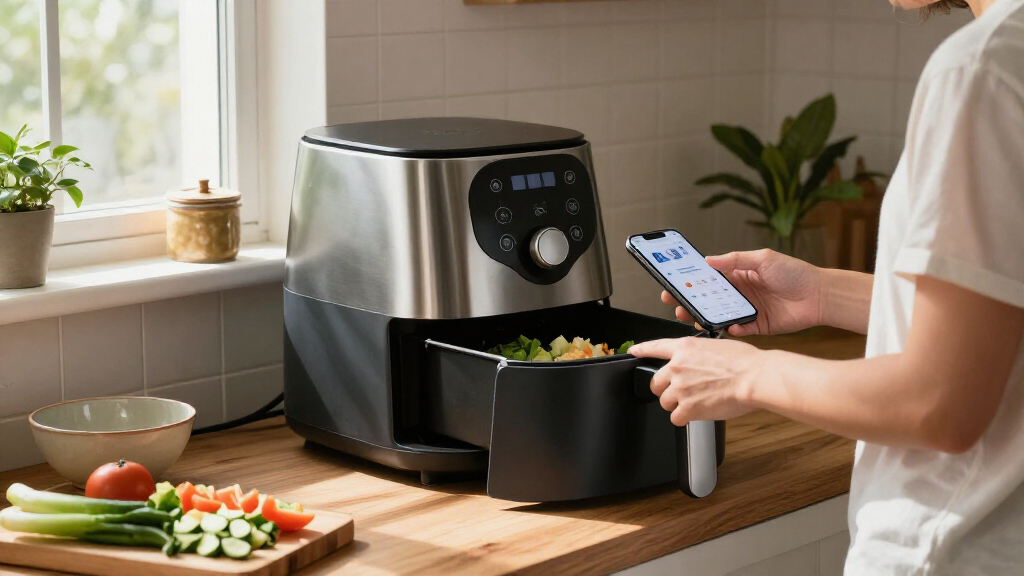

Choosing smart kitchen gadgets is really a choice between connected appliances that add app control and automation, and simpler gadgets that focus on doing one kitchen job with minimal setup. Connected options can make sense for cooks who will use remote monitoring, timers, recipes or smart home integrations; basic versions suit people who mainly want reliable tools at a lower cost. The practical difference is whether those added features change your routine enough to justify their price and upkeep.

Get kitchen gear delivered free with Prime
- Fast, free delivery on millions of items
- Prime Video, Amazon Music and more included
- Member-only deals all year
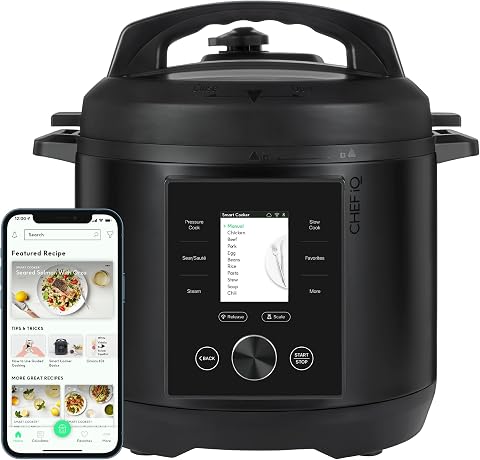
Chef iQ Smart Pressure Cooker with WiFi and Built-in Scale – 10-in-1 Multicooker, 6-Quart Family Size
- ✔ Capacity: 6 quarts
- ✔ Dimensions: 13 x 13 x 13 in
- ✔ Item weight: 10.4 lb

Etekcity Food Kitchen Scale with Nutritional Calculator, Smart App, 11 lb
- ✔ Weight capacity: 11 lb (5,000 g)
- ✔ Increment value: 1 g
- ✔ Stated accuracy: ±2.86 g

TrendPlain 16oz Olive Oil Sprayer with Silicone Pad – Black
- ✔ Capacity: 470 ml (16 oz)
- ✔ Bottle material: BPA-free glass
- ✔ Spray measurement: 0.15 g per press
At a Glance
| Criteria | Connected smart kitchen gadgets | Simple kitchen gadgets | Winner |
|---|---|---|---|
| Purchase cost | Usually higher; added electronics and connectivity raise the upfront cost. | Usually lower, with fewer features and no connected hardware to pay for. | B |
| Setup and everyday operation | May require an app, account, Wi-Fi and updates before all features work. | Typically ready to use with physical controls and little or no configuration. | B |
| Remote control and automation | Can offer remote status, alerts, scheduling and integrations, depending on the product. | Usually limited to manual operation, timers or built-in settings. | A |
| Compatibility and reliability | Features vary by brand and may depend on network access, app support and compatible devices. | Core functions do not depend on Wi-Fi, apps or ecosystem compatibility. | B |
| Privacy and upkeep | May collect usage data and require software support, account maintenance or troubleshooting. | No app account or connected data to manage; upkeep is usually straightforward. | B |
| Best fit | Cooks who will use connected features often and value remote access or automation. | People who want a dependable kitchen tool for a specific task at a lower price. | Depends |
Chef iQ Smart Pressure Cooker with WiFi and Built-in Scale – 10-in-1 Multicooker, 6-Quart Family Size
For households that want a smart kitchen gadget to help get dinner on the table, the Chef iQ Smart Pressure Cooker makes the strongest case in this lineup. It combines pressure cooking with a built-in scale, app-guided recipes, and automatic pressure release, so we can weigh ingredients and follow a cooking flow without reaching for as many separate tools. Its 6-quart capacity suits family meals better than the Etekcity scale or TrendPlain sprayer, neither of which cooks food.The tradeoff is commitment. At 10.4 pounds and roughly 13 inches in each listed dimension, it takes more storage and counter space than either countertop accessory. Its Wi-Fi and Bluetooth connected guidance also means the most distinctive parts of the experience depend on a compatible phone and connectivity. The Etekcity can still track nutrients without giving up a dedicated cooking appliance, and the TrendPlain works without any app at all. Choose Chef iQ when guided multi-function cooking is the goal; skip it if we mostly need a smaller tool for measuring or seasoning.
Pros:
- Built-in scale helps combine ingredient measuring with cooking.
- Wi-Fi and Bluetooth app offers guided video recipes.
- Automatic pressure release includes quick, pulse, and natural methods.
- Six-quart capacity supports family-sized portions.
Cons:
- Bulky footprint and 10.4-pound weight make storage less convenient.
- Connected functions may be limited without Wi-Fi or Bluetooth.
- Product guidance excludes use outside the US and Canada.
Best for: Home cooks who want app-guided pressure cooking and a single appliance that can weigh ingredients and prepare family-sized meals.
Not ideal for: Anyone short on storage, cooking for one with a small appliance preference, or seeking useful connected functions without dependable Wi-Fi or Bluetooth.
Bottom line: We’d choose Chef iQ when smart guidance and pressure cooking can earn a regular place on the counter.
“We’d choose Chef iQ when smart guidance and pressure cooking can earn a regular place on the counter.”
Etekcity Food Kitchen Scale with Nutritional Calculator, Smart App, 11 lb
If weighing food and keeping a closer nutrition log matter more than automating the cooking itself, the Etekcity Food Kitchen Scale is the more targeted smart pick. It pairs an 11-pound scale with the VeSync app, where the supplied details say we can track up to 19 nutrients and sync with Apple Health and Fitbit. That gives it a clearer tracking role than the Chef iQ, whose built-in scale is part of a cooker rather than a dedicated nutrition workflow.The stainless steel platform and selectable units make day-to-day weighing versatile, from solid ingredients to water or milk. Its listed 1 g increments suit routine portioning and recipe measurements, though stated accuracy is ±2.86 g, so we shouldn’t treat the increment as a promise of equivalent absolute accuracy. Unlike TrendPlain’s mechanical oil control, this model introduces an app and regional limits: app functionality is currently limited to the US. Three AAA batteries are required, with no rechargeable option. It’s a useful fit for people who will actually log foods; for cooks who mainly need a guided dinner, the Chef iQ does more, while the TrendPlain is simpler and easier to grab.
Pros:
- Tracks up to 19 nutrients through the VeSync app.
- Syncs with Apple Health and Fitbit.
- Stainless steel platform is easy to clean.
- Supports multiple weight units plus water and milk volume modes.
Cons:
- App functionality is currently limited to the United States.
- Requires three AAA batteries and has no rechargeable option.
- Listed accuracy is ±2.86 g despite 1 g display increments.
Best for: People who regularly weigh ingredients or portions and want nutrition data connected to a compatible health app in the United States.
Not ideal for: Buyers outside the US who need the app, anyone avoiding disposable batteries, or cooks seeking a device that automates meal preparation.
Bottom line: We’d pick Etekcity for routine food weighing and compatible nutrition logging, rather than for cooking automation.
“We’d pick Etekcity for routine food weighing and compatible nutrition logging, rather than for cooking automation.”
TrendPlain 16oz Olive Oil Sprayer with Silicone Pad – Black
The TrendPlain olive oil sprayer is the most focused gadget here: it improves how we dispense oil, rather than weighing food or cooking a complete meal. Its dual spray and pour system lets us mist a surface for more even coverage or pour a steady stream when a recipe calls for it. The stated 0.15 g per spray gives us a consistent measure per press, a practical point of difference from the Etekcity scale, which measures ingredients after we place them on the platform.Its 470 ml glass bottle is a straightforward, app-free option that needs no batteries or connection. A non-slip silicone pad helps stabilize the bottle and protect the counter. Compared with the Chef iQ, it occupies little space and has a much narrower job; compared with Etekcity, it won’t calculate nutrition or weigh other ingredients. We should also account for its glass construction, which can break if dropped, and the lid’s hand-wash requirement. This is a good fit for people who want measured oil dispensing during cooking, but it won’t suit someone looking for broader smart-home functionality or an all-purpose kitchen tool.
Pros:
- Switches between fine spray and steady pour.
- Each spray is stated to dispense 0.15 g for consistent use.
- BPA-free glass bottle with a non-slip silicone pad.
- Compact, app-free design needs no batteries.
Cons:
- Glass bottle can break if dropped.
- Lid must be hand washed and is not dishwasher safe.
- Its focused oil-dispensing function offers less versatility than the scale or multicooker.
Best for: Cooks who want a compact, app-free way to mist or pour oil with a stated per-press measurement.
Not ideal for: Anyone who needs a dishwasher-safe lid, a bottle that can withstand drops, nutrition tracking, or a gadget that handles more than oil dispensing.
Bottom line: We’d choose TrendPlain for simple, controlled oil dispensing when a small manual gadget is all our routine needs.
“We’d choose TrendPlain for simple, controlled oil dispensing when a small manual gadget is all our routine needs.”
As an Amazon Associate we earn from qualifying purchases.
Key Differences
The clearest advantage of connected gadgets is control beyond the appliance itself. A connected thermometer may send a temperature alert while you prepare other food, and a smart oven may support remote monitoring or scheduled functions. Those capabilities can reduce checking and coordination. They matter most when a device is used frequently, the feature works reliably, and remote access is useful in the cook’s actual routine. An app icon or voice assistant listing alone does not make an appliance meaningfully more convenient.
Simple gadgets win on cost and independence. They usually work straight from the box, do not need a stable network, and keep their basic function available even if an app changes or a service ends. The tradeoff is less automation: users may need to check the appliance in person, set controls manually or use a separate timer. For many kitchens, those small tasks are easier than managing another connected device.
Value comes down to repeated use of a specific feature. Paying extra for remote alerts can be worthwhile for someone who regularly cooks long meals or monitors several dishes. Paying more for a feature that duplicates a phone timer or a quick glance at the counter is harder to justify. A useful buying test is to name the task the connected feature will improve, estimate how often it comes up, then compare that benefit with the added purchase cost and setup.
Detailed Comparison
Purchase cost (Simple kitchen gadgets wins — moderate)
Simple gadgets generally cost less because they do not include wireless hardware, software features or app support. The gap is often moderate, but it can be major when comparing a basic tool with a feature-rich appliance. Buyers should compare products that perform the same core task; a higher price only earns its place when the connected functions will be used regularly.
Setup and everyday operation (Simple kitchen gadgets wins — moderate)
Simple gadgets usually win by a minor to moderate margin: plug in, add batteries or use the manual controls, and get started. Connected models can require an app, an account, network access and updates. Once configured, they may be convenient, but setup adds friction for anyone who wants a quick, occasional-use tool.
Remote control and automation (Connected smart kitchen gadgets wins — major)
Connected gadgets win, often by a major margin when remote access is the central need. Alerts, scheduling and app controls can help a cook keep track of food from another room or coordinate tasks. The practical benefit depends on the particular model; a connected label does not guarantee useful automation, and some functions still require hands-on steps.
Compatibility and reliability (Simple kitchen gadgets wins — moderate)
Simple gadgets have the edge because their core operation does not depend on Wi-Fi, a supported phone or a working service. This is a moderate advantage for people with unreliable connectivity or mixed device ecosystems. Connected models may work smoothly for years, but app changes or network problems can affect convenience even when the appliance itself still functions.
Privacy and upkeep (Simple kitchen gadgets wins — minor)
Simple gadgets win by a minor to moderate margin: there is generally no connected account or usage data to manage, and fewer software-related tasks. Connected products may involve app permissions, data collection and periodic updates. Review the manufacturer’s privacy details and support policy before buying, particularly when the appliance records routines or links to other home devices.
Best fit (moderate difference)
The winner depends on how the kitchen is used. Connected gadgets are a better fit for frequent cooks who have a clear use for alerts, remote monitoring or automation. Simple gadgets are a better fit for occasional use, straightforward tasks and shoppers who value low cost and minimal maintenance. The distinction is meaningful, but neither category is the right answer for every appliance.
Connected smart kitchen gadgets: Pros and Cons
Pros:
- Remote alerts and controls can reduce repeated checking.
- Automation and device integrations may simplify frequent cooking routines.
- Useful features can support multi-tasking and monitoring from another room.
Cons:
- Higher purchase cost for features some users may rarely use.
- Setup can involve an app, account, Wi-Fi and updates.
- Convenience may depend on app support, network reliability and data policies.
Simple kitchen gadgets: Pros and Cons
Pros:
- Lower cost for the core kitchen function.
- Simple controls and little setup make occasional use easy.
- Works without an app, account or reliable internet connection.
Cons:
- Limited remote access, alerts and automation.
- More manual checking or control may be needed.
- May lack useful integrations for households already using a connected kitchen system.
Who Should Choose What
Choose Connected smart kitchen gadgets if:
- You cook often and will use remote alerts or controls several times a week.
- You need to monitor food while handling other tasks or moving around the home.
- You already use compatible smart home devices and have confirmed the gadget’s features work with them.
Choose Simple kitchen gadgets if:
- You want an affordable tool for a clear, occasional kitchen task.
- You prefer physical controls and want the appliance to work without an app or Wi-Fi.
- You would rather avoid accounts, software updates and connected data policies.
Skip both if: Skip connected and basic gadgets alike if you do not have a recurring kitchen task they solve; an existing tool or a manual method may be enough.
Value for Money
Paying more for connected features is worthwhile when they solve a frequent, specific problem, such as checking a roast remotely or coordinating a cooking schedule. In that case, the extra cost buys time and fewer interruptions. For a gadget used occasionally, or one whose main benefit is a timer you can already set on your phone, the simple model is usually better value. Compare the price difference with the feature you will actually use, and check whether core operation remains available if the app or network does not.
Final Verdict
For most shoppers who want a useful kitchen tool without added setup, simple gadgets are the safer value: they cost less and keep their core job straightforward. Choose connected gadgets when remote monitoring, alerts or automation solve a repeated problem in your cooking routine, and pay more only for features you expect to use often. The deciding factor is not how many smart features a product lists, but whether one of them reliably makes a regular task easier.
Frequently Asked Questions
Are smart kitchen gadgets worth the extra cost?
They can be, if you will use remote monitoring, alerts or automation regularly. If the connected features duplicate a timer or a quick in-person check, a simple gadget is usually better value.
Do connected kitchen gadgets work without Wi-Fi?
Some retain basic manual functions, while app controls, alerts and integrations may stop working without a connection. Check the product details to see which core features remain available offline.
What should I check before buying a smart kitchen appliance?
Confirm that the features you want are supported in your home, review setup requirements and check how the product handles data and software support. Make sure the appliance still performs its main job if the app is unavailable.
Which is better for a small or occasional-use kitchen?
Simple gadgets are usually the better fit because they take less setup and cost less. Choose a connected model only when a specific feature solves a recurring constraint, such as monitoring food while away from the kitchen.