When people compare electric roasting pans, the real choice is often whether to buy a dedicated countertop cooker or keep using a conventional oven. An electric roaster can make sense for holiday turkey, potlucks, or a kitchen where oven space is scarce; the oven is usually the more flexible choice for households that roast only occasionally or need to cook several dishes at once. The main tradeoff is focused capacity and a separate heat source versus greater versatility and room to coordinate a full meal. Choose based on how often you cook large roasts, how much oven space matters, and whether another appliance would earn its storage space.

Get kitchen gear delivered free with Prime
- Fast, free delivery on millions of items
- Prime Video, Amazon Music and more included
- Member-only deals all year

28 Quart Electric Roaster Oven with Self-Basting Lid, Stainless Steel
- ✔ Brand: Kiss the Water
- ✔ Model: R0220
- ✔ Capacity: 28 quarts
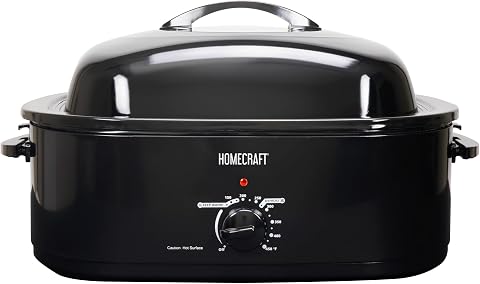
HomeCraft Electric Roaster Oven, 18-Quart, Black
- ✔ Brand: HomeCraft
- ✔ Model: HCRO18BK
- ✔ Capacity: 18 quarts

SUNVIVI 24-Quart Roaster Oven with Three Buffet Trays
- ✔ Brand: SUNVIVI
- ✔ Model: ZER01X
- ✔ Capacity: 24 quarts
At a Glance
| Criteria | Electric roasting pan | Conventional oven | Winner |
|---|---|---|---|
| Cooking capacity and shape | A removable cooking well accommodates many roasts and some whole birds, subject to the unit’s capacity and dimensions. | A full-size cavity can accommodate large trays and offers more room to arrange dishes, depending on oven size. | Depends |
| Temperature control and results | Adjustable thermostats provide a set temperature, but heating patterns and browning can vary by model. | Established controls and multiple rack positions support varied cooking, though actual temperature accuracy differs by oven. | B |
| Kitchen workload and oven space | Sits on a heat-safe counter and leaves the main oven free for sides. | Uses the main oven, limiting what can cook there at the same time. | A |
| Energy and preheating | A smaller chamber may need less energy than heating a full oven for a suitably sized roast; results depend on food, model, and cooking time. | Heating a large cavity can use more energy for a small roast, though efficiency varies with oven and cooking time. | A |
| Versatility and storage | Useful for roasting, warming, and some slow-cooking tasks; takes dedicated counter or cupboard space. | Supports a broad range of baking and roasting tasks without adding another appliance. | B |
| Purchase value | Worth the cost for frequent large meals or scarce oven space; an occasional-use appliance may be poor value. | Already owned in most kitchens, so it usually costs nothing extra for roasting. | B |
28 Quart Electric Roaster Oven with Self-Basting Lid, Stainless Steel
The Kiss the Water 28-quart roaster is our most balanced choice for cooks who want one appliance to cover more than a holiday roast. Its stated 150–450°F range and listed roasting, baking, slow-cooking, defrosting, and warming modes give it a broader job description than HomeCraft, whose description centers on roasting, thawing, and warming. That versatility helps if we plan to use a roaster through the year, though the product details do not tell us how precisely it holds a set temperature.Its visible self-basting lid is the clearest differentiator: we can monitor food without lifting the lid, and the design is intended to circulate moisture. The removable stainless-steel pan and rack also make handling and cleaning more straightforward than a fixed interior would. Compared with SUNVIVI, it has more stated capacity and a simpler accessory package; SUNVIVI is the better fit when buffet-style serving matters more than the extra four quarts.The tradeoff is substantial counter and storage demand. The listed dimensions are 27 inches deep by 22 inches wide, larger than either competitor in at least one stated dimension, and its 14.7-pound weight can make moving it inconvenient. Its knob controls also do not offer the interface detail some buyers may want. We would choose it for broad capability and frequent large-batch cooking, but skip it if cabinet space is tight or a smaller roast is the norm.
Pros:
- 28-quart capacity for large meals
- Visible self-basting lid helps monitor food without opening the roaster
- Listed 150–450°F range and multiple cooking modes
- Removable stainless-steel pan and rack
Cons:
- Large 27-inch-deep footprint can be difficult to store
- At 14.7 pounds, it may be awkward to move
- Knob controls offer less interface detail than digital controls
Best for: Households that cook large roasts and want listed modes for roasting, baking, slow cooking, defrosting, and warming.
Not ideal for: Buyers with limited counter or storage space, or anyone who prefers digital temperature controls.
Bottom line: Choose this model when broad stated cooking functions and a large visible-lid roaster matter more than compact storage.
“Choose this model when broad stated cooking functions and a large visible-lid roaster matter more than compact storage.”
HomeCraft Electric Roaster Oven, 18-Quart, Black
HomeCraft is the smallest-capacity model in this comparison, which is an advantage when we do not need the 24- or 28-quart space of the other picks. At 18 quarts, it is described as suitable for whole turkeys and large roasts, while its listed width of about 15.35 inches is notably narrower than the Kiss the Water and SUNVIVI units. That makes it the more practical starting point for kitchens where counter width or storage space limits the choice.The design keeps the essentials straightforward: a removable enamel pot, stainless-steel lift-out rack, high-dome lid, and cool-touch handles. The rack helps us lift food out for carving, and the removable pot separates the cooking surface from the outer unit for cleanup. In contrast with Kiss the Water’s longer mode list and SUNVIVI’s buffet accessories, HomeCraft is focused on roasting, thawing, and warming. Its description mentions three temperature settings via the knob, even though the listed control is described as full-range up to 450°F; we should check the current listing to understand how that control is presented.That simpler setup is also a limit. It has less capacity than either rival and lacks the stated baking and slow-cooking modes of the other two. The supplied description does not list a wattage or an exact operating range below the 450°F maximum. We would favor it for households that want core roaster functions without buffet trays or the largest footprint, but buyers planning very large turkeys or varied roaster recipes should choose one of the higher-capacity options.
Pros:
- 18-quart capacity for whole turkeys and large roasts
- Narrower stated width than the other two models
- Removable enamel pot and lift-out rack
- Cool-touch handles and high-dome lid
Cons:
- Less capacity than the 24- and 28-quart alternatives
- Fewer cooking modes are listed in the product description
- Control description leaves the number of usable temperature settings unclear
Best for: Buyers who want an 18-quart roaster for family-sized roasts and have less storage width available.
Not ideal for: Cooks who regularly prepare very large turkeys, need buffet trays, or want a broader set of stated cooking modes.
Bottom line: Pick HomeCraft when a narrower, simpler roaster better fits your kitchen and usual meal size than a larger multi-mode model.
“Pick HomeCraft when a narrower, simpler roaster better fits your kitchen and usual meal size than a larger multi-mode model.”
SUNVIVI 24-Quart Roaster Oven with Three Buffet Trays
SUNVIVI stands out because it makes the move from cooking to serving part of the package. Its three buffet trays and divider pan give us a way to keep side dishes warm alongside the main roast, a useful distinction from the Kiss the Water and HomeCraft, which are presented primarily as roasting appliances. If a holiday meal means several dishes need to stay ready together, those accessories may matter more than having the biggest single roasting chamber.The 24-quart capacity sits between the lineup’s 18- and 28-quart options, and the stated maximum turkey capacity is 28 pounds. Its 150–450°F thermostat and listed roasting, defrosting, baking, slow-cooking, and warming modes also make it more versatile on paper than HomeCraft. The self-basting dome lid is another shared point with Kiss the Water, but SUNVIVI’s strongest distinction is what happens after cooking: serving and keeping sides warm.There are tradeoffs. The listed 25-inch width and 17-inch height still require meaningful counter or cupboard space, and the pan and buffet accessories need separate cleaning. The trays are identified as dishwasher-safe, which helps, but that does not remove the need to handle multiple parts. Button controls differ from the knob controls on both competitors, though the provided details do not establish finer temperature precision. We would choose SUNVIVI for meal service and accessory flexibility; for maximum stated capacity and a visible lid, Kiss the Water remains the stronger all-around roaster.
Pros:
- Three buffet trays and divider pan support serving side dishes
- Stated capacity for a turkey up to 28 pounds
- 150–450°F range with multiple listed cooking modes
- Dishwasher-safe buffet trays and removable roasting pan
Cons:
- 25-inch width requires considerable counter or storage room
- Multiple trays and the roasting pan create separate cleanup tasks
- 24-quart capacity is below the Kiss the Water model
Best for: Hosts who want to roast a large turkey and keep several side dishes warm for serving.
Not ideal for: Buyers who want a minimal cleanup routine, a compact appliance, or the largest roasting capacity in this lineup.
Bottom line: Choose SUNVIVI when buffet-style serving and keeping sides warm are central to the meal.
“Choose SUNVIVI when buffet-style serving and keeping sides warm are central to the meal.”
As an Amazon Associate we earn from qualifying purchases.
Key Differences
The clearest advantage of an electric roasting pan is workload separation. It can cook a roast on the counter while the oven handles pies, vegetables, or casseroles. That is a meaningful gain for a holiday meal or a small kitchen with limited oven capacity. For a modest roast cooked without competing dishes, however, the separate appliance may simply add another item to clean and store.
The conventional oven has the stronger case for flexibility and coordinated cooking. It can fit a wider range of trays, supports multiple rack positions, and serves many jobs beyond roasting. Electric roasters can produce satisfying slow-cooked meat, but their shape, thermostat behavior, and browning differ by model. Neither type automatically guarantees better results: capacity, temperature behavior, recipe, and cooking method all matter.
Energy savings are possible when a smaller electric roaster replaces a much larger oven for a suitably sized meal, but there is no universal savings figure. Cooking time, appliance efficiency, and how often the oven is opened affect the comparison. The practical value is clearest when the roaster gets regular use and frees the oven during meals that need several dishes. Otherwise, use the oven you already have.
Detailed Comparison
Cooking capacity and shape (moderate difference)
Winner: Depends (moderate gap). A full-size oven usually offers more room and rack flexibility, which helps when a roast shares the meal with several trays. An electric roaster’s deep, compact well can suit a single roast or bird, but capacity varies. Check the interior dimensions against the food and pan you plan to use; advertised volume alone does not tell you whether a particular bird will fit.
Temperature control and results (Conventional oven wins — moderate)
Winner: Conventional oven (minor to moderate gap). An oven’s rack positions and established baking functions make it easier to coordinate different dishes. Electric roasters offer adjustable heat and can cook a roast effectively, but models differ in how evenly they heat and how well they brown. Follow the appliance manual and verify doneness with a food thermometer rather than relying only on a dial or cooking time.
Kitchen workload and oven space (Electric roasting pan wins — major)
Winner: Electric roasting pan (major gap when the oven is busy). A countertop roaster adds a separate cooking space, so the oven can handle sides or desserts while the main dish cooks. That can materially simplify a large meal. If the oven is usually free, the benefit shrinks; the electric pan still needs a safe, heat-resistant place to operate.
Energy and preheating (Electric roasting pan wins — minor)
Winner: Electric roasting pan for an appropriately sized roast (minor, variable gap). Its smaller chamber may take less energy to heat than a full oven, especially for a long cook. Actual savings depend on the appliance, cooking duration, and food size, and should not be assumed for every recipe. For small, occasional meals, the difference may not justify buying and storing a new appliance.
Versatility and storage (Conventional oven wins — major)
Winner: Conventional oven (major gap). The oven handles roasting alongside baking and many other everyday cooking jobs, and it does not require extra cupboard space if already installed. Most electric roasters focus on roasting, warming, and related slow cooking. They are more attractive in a kitchen with room to store one and a recurring need for extra cooking capacity.
Purchase value (Conventional oven wins — moderate)
Winner: Conventional oven for most households (moderate gap). If an oven is already available, roasting in it avoids an additional purchase. A dedicated electric roaster earns its cost when frequent large meals, potlucks, or limited oven space make its separate heat source useful. Paying more for extra capacity or features makes sense only if those capabilities match food you regularly prepare.
Electric roasting pan: Pros and Cons
Pros:
- Frees the conventional oven for sides and other dishes.
- May use less energy than heating a full-size oven for a suitable roast.
- Useful for roasting and keeping food warm during large gatherings.
Cons:
- Requires additional purchase and storage space.
- Interior size and heating behavior vary by model.
- Less flexible than an oven for baking and cooking several dishes together.
Conventional oven: Pros and Cons
Pros:
- Versatile for roasting, baking, and many other meals.
- Usually offers more room and rack arrangements.
- No added appliance purchase if the kitchen already has one.
Cons:
- A roast occupies the oven that sides or desserts may need.
- Heating the full cavity for a small roast may be inefficient.
- A busy oven can complicate meal timing.
Who Should Choose What
Choose Electric roasting pan if:
- You cook large holiday meals or potluck dishes often and need the oven free for other food.
- Your oven is small, unreliable, or unavailable during a remodel, and you have a safe place to operate and store a roaster.
- You regularly cook roasts sized to the model’s actual interior dimensions.
Choose Conventional oven if:
- You roast only occasionally and already have a working oven.
- You need flexible rack space to cook a roast alongside trays of sides.
- You want one appliance for roasting and a wide range of everyday cooking.
Skip both if: Neither is a fit if you do not have a safe, suitable cooking space or the food you need to prepare exceeds the usable capacity of both appliances; consider a different cooking method sized to your meal.
Value for Money
For most households, the oven is the better value because it is already part of the kitchen and serves more purposes. An electric roasting pan is worth paying for when it solves a recurring problem: a crowded oven, a large seasonal meal, or a need to transport or serve warm food. Consider how often you would use it and where it will live between meals. A low purchase price does not make it good value if it spends most of the year in a cupboard.
Energy use can add to the roaster’s case, but savings depend on the appliance and cooking pattern. Treat lower energy use as a possible benefit rather than a guaranteed payback. Buy a model with capacity that matches your usual roast, clear temperature controls, and removable parts that are manageable to clean. Extra features are worth paying for only when they solve a task you routinely face.
Final Verdict
Choose a conventional oven if you roast occasionally, need room for multiple trays, or want the broadest cooking range without another purchase. For most households, that is the sensible default. Choose an electric roasting pan if large meals are frequent and keeping the main oven available would make preparation noticeably easier. The deciding factor is how often you need a second cooking space: if the answer is rarely, skip the roaster; if it is several times a year and oven space is a real bottleneck, the added appliance can earn its place.
Frequently Asked Questions
Is an electric roasting pan better than an oven for turkey?
Either can cook a turkey when it fits the appliance and you follow the manufacturer’s directions. A roaster can free the oven for side dishes; an oven gives more rack flexibility. Check the turkey’s size against the roaster’s interior, and use a food thermometer to check doneness.
Do electric roasting pans use less electricity?
They may use less energy than heating a full-size oven for a suitably sized roast because their cooking chamber is smaller. The actual difference varies with the model, food, and cooking time, so it is not guaranteed for every meal.
Can an electric roaster replace a conventional oven?
No. It can cover roasting and some warming or slow-cooking tasks, but it does not offer the same range of baking functions, rack positions, or capacity for multiple dishes. It works best as a supplement for people who regularly need extra cooking space.
Is an electric roasting pan worth buying for occasional use?
Usually not if your oven works and you roast only once in a while. The roaster’s value rises when it solves a repeated problem, such as holiday oven crowding or a small oven. Account for storage and cleanup as well as purchase price.