
TL;DR

Get kitchen gear delivered free with Prime
- Fast, free delivery on millions of items
- Prime Video, Amazon Music and more included
- Member-only deals all year
Good Housekeeping reports that ceiling fans can be used year-round: clockwise rotation is recommended for winter, while counterclockwise rotation is recommended for summer. The fan may help people feel comfortable and adjust heating or cooling use, but the source does not quantify savings from changing fan direction alone.
Good Housekeeping has published guidance on using ceiling fans in both warm and cold seasons, recommending clockwise rotation in winter and counterclockwise rotation in summer. The advice matters for homeowners seeking seasonal comfort and possible energy savings, though the report does not provide measured savings attributable to fan direction alone.
In winter, the report says a fan should spin clockwise at a low setting to move warmer air that has risen toward the ceiling back down into the room. The intended effect is to make the space feel more comfortable without creating the stronger cooling sensation associated with a breeze. The report does not specify a universal speed setting, so users should follow their fan’s instructions and choose a setting that does not make occupants feel colder.
For summer, the recommended direction is counterclockwise. That rotation moves air downward, creating airflow over people in the room and helping them feel cooler. A fan circulates air rather than lowering the room’s temperature, so it does not replace an air conditioner when cooling is needed. The report presents the fan as a way to support comfort and potentially reduce how much heating or cooling a household uses.
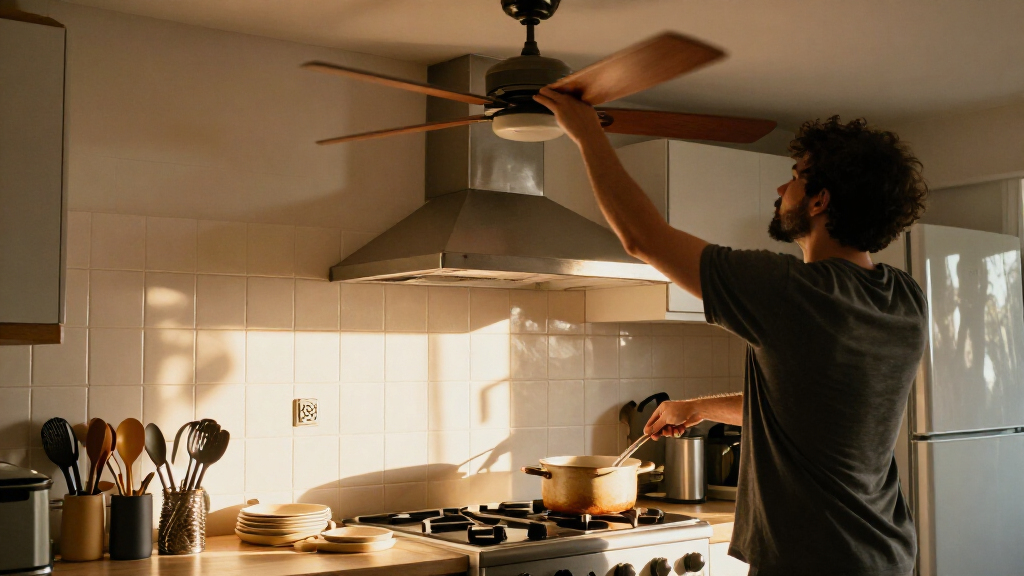
How to reverse a fan depends on its controls. A remote-controlled model may have a reverse button, often marked with a circular-arrow symbol. Many conventional models have a small physical switch on the fan’s housing near the pull chain and light. Good Housekeeping advises turning a conventional fan completely off before operating that switch. Users should consult the manufacturer’s instructions if the controls or rotation direction are unclear.
Seasonal Airflow and Energy Use
Changing the direction can alter how air moves through a room, which may affect perceived comfort without changing the thermostat setting. In summer, moving air can make people feel cooler; in winter, gently circulating ceiling-level warm air downward may make temperatures feel more even. Those effects can matter to households trying to balance comfort with heating and cooling use.
The report cites the U.S. Department of Energy as saying that adjusting a thermostat by about seven degrees during the day could reduce heating and cooling costs by as much as 10% over a year. That figure concerns thermostat adjustments, not a guaranteed saving from reversing a ceiling fan. Actual results depend on the home, weather, equipment, thermostat schedule and occupants’ habits. A fan should be treated as a possible complement to heating and cooling, not proof of a specific bill reduction.
ceiling fan remote control with reverse button
As an affiliate, we earn on qualifying purchases.
As an affiliate, we earn on qualifying purchases.
How Reversing Changes Airflow
Ceiling fans have reversible blade rotation, and the two directions are used for different seasonal effects. The supplied Good Housekeeping report draws on guidance from its Home Improvement & Outdoor Lab, whose director, Dan, has experience with home maintenance and renovation reporting. The article explains that warm air rises and collects near the ceiling, while airflow across occupants can make a warm-weather room feel cooler.
The report’s practical distinction is straightforward: use a clockwise setting in colder months to encourage gentle downward circulation, and counterclockwise rotation in warmer months to create a cooling breeze. The exact appearance of the control and the fan’s operation can vary by model. This is why the manufacturer’s directions are useful, particularly where a remote or switch label is not obvious.
““you’ll want to make sure your fan is spinning clockwise” in winter”
— Good Housekeeping report
As an affiliate, we earn on qualifying purchases.
Savings Depend on the Home
The supplied report does not give a publication date, identify a particular fan model, or provide test results comparing household bills with different fan directions. It also does not quantify how much a fan setting alone might change energy use. The cited up-to-10% estimate concerns a thermostat adjustment of around seven degrees during the day, and should not be interpreted as a ceiling-fan savings guarantee.
How much comfort a fan provides can vary with room layout, ceiling height, fan speed, outdoor conditions and personal preference. The report does not specify a single speed or thermostat schedule that suits every home. Whether a fan’s control is a button, switch or another mechanism also depends on its design.
As an affiliate, we earn on qualifying purchases.
Check the Fan Before Reversing
Homeowners can check the fan’s manual or manufacturer guidance to identify the reverse control and confirm the recommended direction. For a conventional fan with a physical direction switch, turn the fan completely off before moving the switch, as the report advises. After changing the setting, users can observe the airflow and adjust the fan speed for comfort.
The report offers no scheduled follow-up, product test or additional announcement. The practical next step is to use the seasonal direction as general guidance, then rely on the fan’s instructions and household comfort rather than assuming a specific energy-bill reduction.
As an affiliate, we earn on qualifying purchases.
Key Questions
Which direction should a ceiling fan spin in winter?
The Good Housekeeping report recommends clockwise rotation in winter to help move warm air near the ceiling back down into the room. A low setting may help avoid a breeze that feels cooling; check the fan’s instructions for model-specific guidance.
Which direction is recommended for summer?
The report recommends counterclockwise rotation in summer to move air downward and create airflow that can make people feel cooler. A fan circulates air; it does not replace air conditioning when the room needs active cooling.
How do I change my ceiling fan’s direction?
A remote-controlled fan may have a reverse button, sometimes shown with circular arrows. Many conventional fans have a physical switch on the housing near the pull chain and light. Turn the fan off first before using a physical direction switch, and consult the manual if the control is not clear.
Will reversing my fan cut my energy bill by 10%?
No specific fan-direction saving is established in the supplied report. Its cited estimate of up to 10% refers to adjusting a thermostat by around seven degrees during the day over the year, not to reversing a ceiling fan.
Source: rss
Halloween Picks
halloween
As an affiliate, we earn on qualifying purchases.