
TL;DR

Get kitchen gear delivered free with Prime
- Fast, free delivery on millions of items
- Prime Video, Amazon Music and more included
- Member-only deals all year
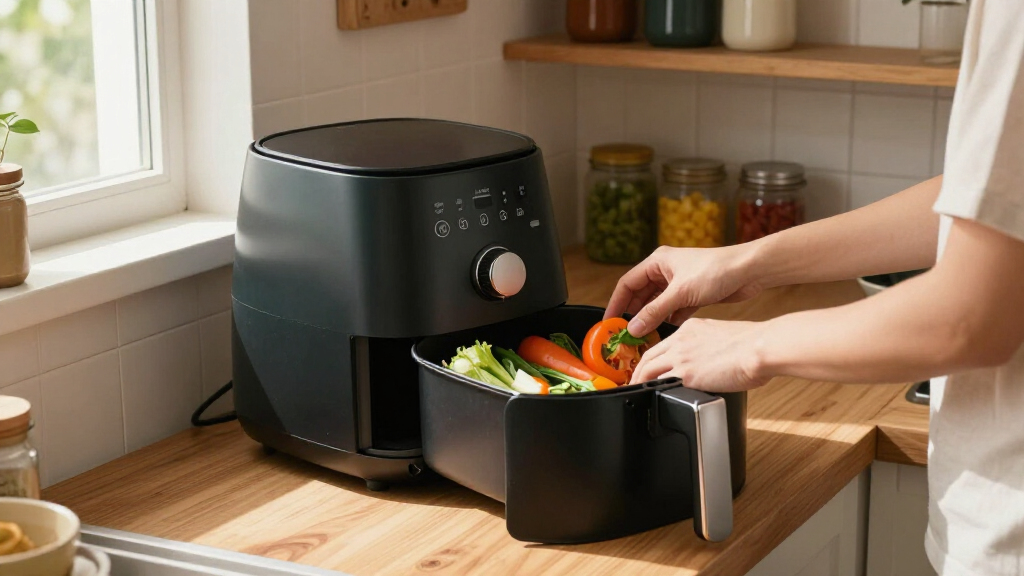
Air fryers for small kitchens work best when they pair a wide 3–4-quart basket with compact external dimensions and safe ventilation space. Measure the appliance, open drawer, and required clearances before buying, then choose useful cooking area over an impressive capacity number.
A full-size oven can feel absurd when you only want one tray of vegetables or two crisp fish fillets. It heats the room, warms the cabinets, and turns a quick dinner into a production. In a small kitchen, that is a lot of heat and space for one modest meal.
You will learn how to choose the right capacity, compare basket and oven-style models, measure for safe airflow, and avoid features that merely decorate the control panel. The goal is simple: find an appliance that earns its counter space every week.
Choose roughly 3–4 quarts for one or two people, but favor a wide square basket over a taller basket with the same stated volume.
Measure the appliance, open drawer, ventilation clearance, and outlet location before spending any money.
A basket model suits fast crisping, while a toaster-oven model makes more sense when it can replace your existing toaster.
Leave space around food, dry wet ingredients, and shake or turn them instead of adding more oil.
Clean grease and crumbs promptly, and replace baskets with peeling or badly damaged coatings.
Why One Small Appliance Can Earn Its Counter Space
Air fryers for small kitchens are compact convection ovens that move hot air around food, creating browned edges without heating a full-size oven. According to current appliance energy data, they commonly draw 1,000–1,800 watts, yet the smaller chamber and shorter cooking time can cut total electricity for one or two portions [1].
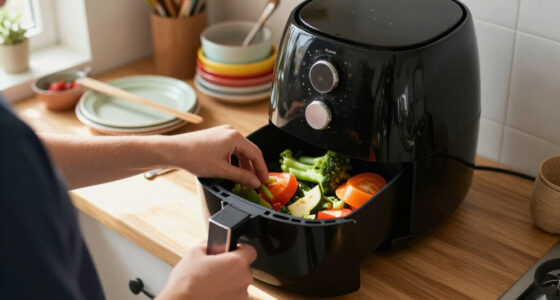
That is why air fryers suit small kitchens: speed, crispness, and less escaped heat arrive in one box. For example, on a humid August evening in a studio apartment, you can roast green beans and a salmon fillet without making the room feel like a sauna. The fan hums, but the kitchen stays more comfortable.
- Roast vegetables and small cuts of meat.
- Reheat pizza without a rubbery crust.
- Bake or dehydrate small portions on supported models.
- Crisp frozen food with little or no added oil.
Air fryers are most useful when they replace repeated oven use, not when they become another appliance gathering dust.
small countertop air fryer 3 quart
As an affiliate, we earn on qualifying purchases.
As an affiliate, we earn on qualifying purchases.
Choose 3–4 Quarts Without Buying a Countertop Bully
Air fryers for small kitchens work best at about 3–4 quarts for one or two people, while a 2-quart model suits snacks or one light serving. A wide, square basket usually beats a deep round one because usable cooking surface matters more than the volume printed on the box [1].
- About 2 quarts: one light serving, snacks, or side dishes.
- About 3–4 quarts: everyday meals for one or two people.
- About 5–6 quarts: larger portions, with a bigger countertop footprint.
For example, suppose you cook two salmon fillets with green beans. A wide 4-quart basket may hold them in a single layer, while a tall 5-quart basket forces the beans beneath the fish, where they steam instead of blister. It is like choosing a wide parking lot over a narrow multistory garage: the total capacity may look similar, but only one gives every piece an open space. These key facts and measurements matter more than a glossy badge claiming family capacity.
Check the external dimensions, inner basket measurements, handle depth, and drawer travel. If you regularly cook two foods at different temperatures, a stacked dual-basket model saves width, while a side-by-side model may swallow half a narrow counter.
compact convection oven for small kitchen
As an affiliate, we earn on qualifying purchases.
As an affiliate, we earn on qualifying purchases.
Pick the Style That Replaces the Right Appliance
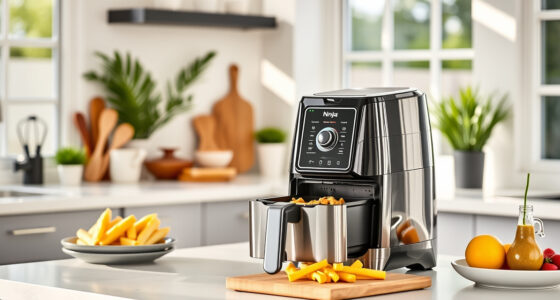
The right air-fryer style replaces an appliance you already use without stealing more space than it saves. A basket model wins for speed and crispness; a toaster-oven style handles toast and baking; a multicooker cuts appliance count but can feel as awkward as a toolbox on a high shelf.
| Style | Best use | Space advantage | Main tradeoff |
|---|---|---|---|
| Basket air fryer | Fast meals and crisp leftovers | Usually the smallest footprint | Limited cooking surface |
| Air-fryer toaster oven | Toast, baking, roasting, and broiling | Can replace a toaster | Wider and slower to clean |
| Multicooker with air-fry lid | Pressure cooking plus crisping | Combines several functions | Tall, heavy, and awkward to store |
For example, if breakfast means two slices of toast and dinner means a tray of roasted vegetables, an air-fryer toaster oven may replace two machines. If you mostly revive a handful of fries after work, a basket model is faster and easier to scrub. A multicooker makes more sense for someone who pressure-cooks beans on Sunday and crisps chicken on Tuesday. Buy for your most common meal, not a once-a-year rotisserie experiment.
wide basket air fryer for quick crisping
As an affiliate, we earn on qualifying purchases.
As an affiliate, we earn on qualifying purchases.
Measure Your Counter in Five Minutes and Avoid a Hot Mistake
Air fryers for small kitchens need more room than their footprint suggests because hot exhaust must escape and the drawer must open fully. Measure the body, manufacturer-required clearances, and pull-out space before buying; a compact-looking unit can still collide with a shallow counter or low cabinet.
- Measure the available width, depth, and height.
- Add the manual’s required rear and overhead clearance.
- Measure the drawer or door when it is fully open.
- Mark the complete footprint with paper and leave it on the counter for a day.
- Check that an appropriate wall outlet is within easy cord reach.
For example, a machine may occupy only a modest rectangle while closed, yet its open drawer can extend into the spot where you normally set a cutting board. The paper outline makes that conflict surprisingly clear. If it blocks the kettle every morning or leaves nowhere to chop an onion, the appliance is too large. Also keep vents away from curtains, paper, walls, and cabinets, and never run the machine inside a closed appliance garage.
Plug the air fryer directly into a suitable outlet rather than an unsuitable extension cord. If the plug, cord, or outlet becomes hot, smells scorched, or repeatedly trips a breaker, stop using the appliance and call a licensed electrician. Electrical repairs call for circuit power off and appropriate PPE, not a hurried DIY fix.
Clear counter space is not wasted space; around a hot exhaust vent, it is part of the appliance.
small space air fryer with safe ventilation
As an affiliate, we earn on qualifying purchases.
As an affiliate, we earn on qualifying purchases.
Get Crisp Food Without Wasting Energy or Oil
You get crisp food by leaving room for moving air, drying wet surfaces, and turning food during cooking. One teaspoon of oil can help vegetables brown, but extra oil cannot rescue a packed basket; crowded potato wedges steam against each other and emerge pale and soft.
- Pat fish, tofu, and vegetables dry before cooking.
- Arrange food in a loose single layer when possible.
- Shake fries or turn proteins partway through.
- Cook additional batches rather than piling food above the basket’s useful depth.
For example, twelve potato wedges spread across the basket can develop crisp golden faces, while the same wedges piled into a mound trap moisture like wet laundry in an overfilled dryer. Giving them space and shaking once midway does more for texture than pouring in another spoonful of oil.
An air fryer often uses less total electricity than an oven for one or two portions, but the advantage shrinks if you need three batches. A microwave still wins for soup, rice, and moist leftovers; the air fryer wins when you want browned cheese, crackling crumbs, or a firm crust. Reheated pizza shows the contrast in minutes.
Less added oil can lower fat and calories compared with deep-frying, yet air-fried does not mean healthy. Frozen snacks keep their salt, refined starch, and existing fat. According to food-safety guidance, cook potatoes to golden yellow rather than dark brown to limit acrylamide formation [2].
Choose Features You Will Use and Keep the Basket Fresh
The best small-kitchen features reduce daily friction: a wide basket, washable parts, clear temperature controls, automatic shutoff, a cool handle, and a manageable cord. Viewing windows and stacked zones can help, while Wi-Fi rarely changes the hands-on work of loading, shaking, and removing food.
- Prioritize: even cooking, low noise, accurate heat, and easy cleaning.
- Check: coating materials and replacement-basket availability.
- Skip: numerous presets if you prefer manual time and temperature.
- Match: overhead clearance to windows, lids, or stacked zones.
For example, someone who cooks chicken and vegetables four nights a week will benefit more from a dishwasher-safe basket and a clear temperature dial than from eighteen named presets. A viewing window may save repeated drawer checks, while Wi-Fi cannot shake the fries or wash the tray.
Clean greasy or crumb-covered parts after use. Yesterday’s garlic chicken can turn into today’s blue-gray smoke when old grease reaches the heating area. Unplug the appliance, let it cool completely, and use a soft sponge rather than metal tools.
Replace baskets with peeling, blistered, or badly scratched coatings. Stainless-steel interiors and clearly documented ceramic-style coatings appeal to buyers concerned about PFAS-related materials, though each surface has its own care needs. Loose parchment can fly toward the heater, so use it only when the manual permits and weight it with food.
Frequently Asked Questions
Is an air fryer worth buying for one person?
Yes, if you often cook small portions or want crisp leftovers without heating an oven. A 2–4-quart model usually offers enough room without dominating the counter.
Can an air fryer replace my oven or microwave?
It can replace an oven for many small meals, but not large casseroles, multiple trays, or serious baking projects. Keep the microwave for soups, liquids, rice, and fast moist reheating.
What capacity works best for two people?
Most couples will find 3–5 quarts practical, depending on portion size. A wide cooking surface often holds two fillets or chicken pieces better than a deeper basket with the same volume.
Why is food not getting crispy in my small air fryer?
The usual causes are crowding, surface moisture, low heat, or too little time. Pat the food dry, leave open gaps, and shake or turn it midway.
Where should I store an air fryer in a tiny kitchen?
Store it clean, dry, and completely cool on a strong low shelf or in a deep drawer. If you use it several times a week, a permanent ventilated counter position will be far more convenient.
Conclusion
Choose an air fryer by the meals you actually cook, then give it a safe, permanent place where it will not crowd your prep area. The winning model is the one that delivers golden edges on Tuesday night without making your counter feel like a packed suitcase.
Columbus Day / Indigenous Peoples' Day Picks
long weekend sales
As an affiliate, we earn on qualifying purchases.