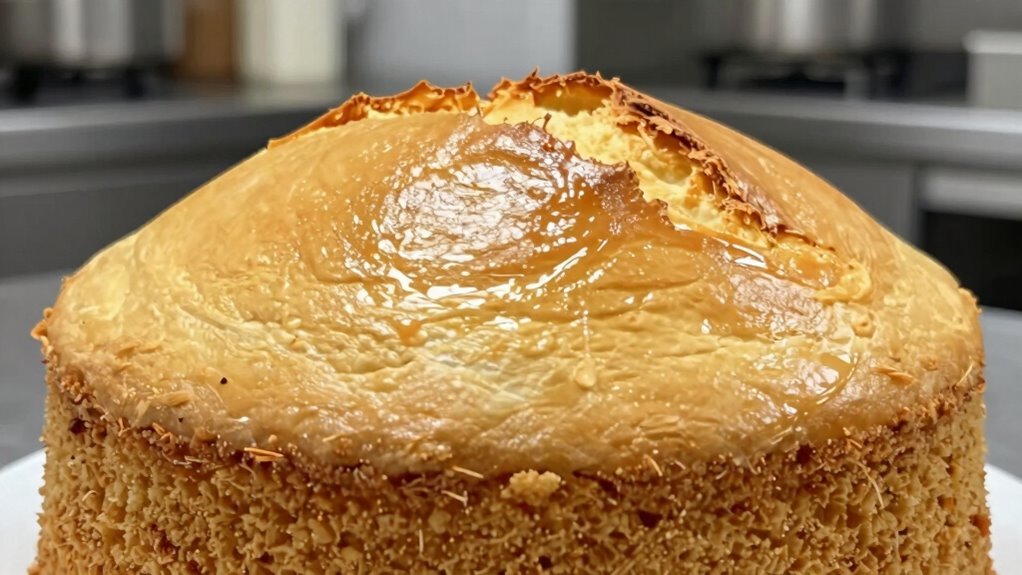

Your cake domes in the middle when the outside sets too quickly, trapping steam that pushes the center upward. To prevent this, check your oven temperature with a reliable thermometer and avoid opening the door early, which can cause temperature drops. Use proper batter consistency and prepare your pans well. Positioning and rotating the cake can also help with even heat distribution. Staying attentive to these factors can help you bake a more level cake—there’s more to uncover if you keep going.
Key Takeaways
- Baking at too high a temperature causes rapid outside setting, leading to doming before the center is fully baked.
- An overly thick batter resists expansion, resulting in a domed center as it struggles to rise evenly.
- Uneven oven heat or hot spots can cause the middle to dome while edges set prematurely.
- Opening the oven door early or frequently can cause temperature drops, affecting even rise and causing doming.
- Proper pan preparation and placing the cake on the middle rack promote uniform heat distribution, preventing doming.
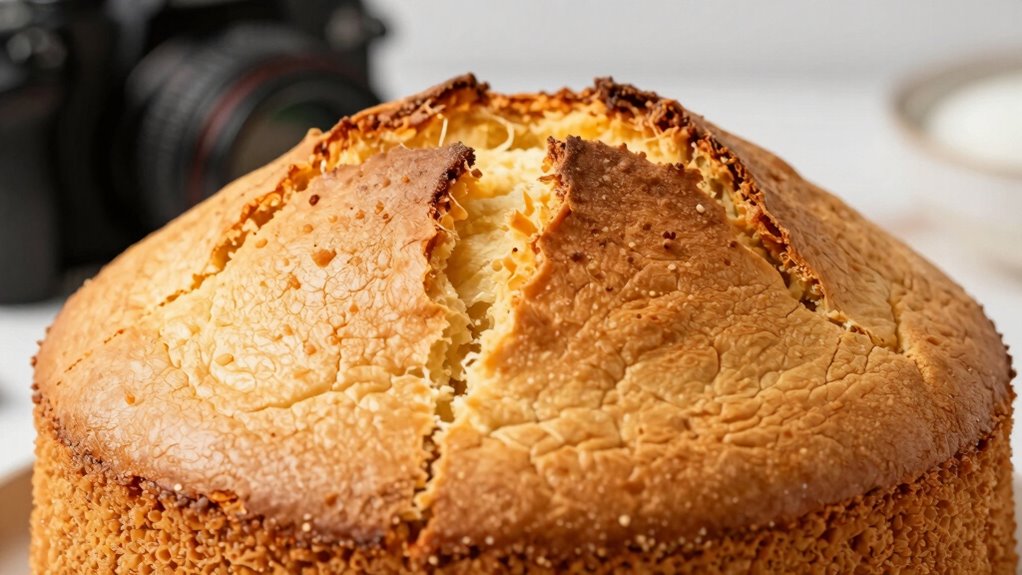
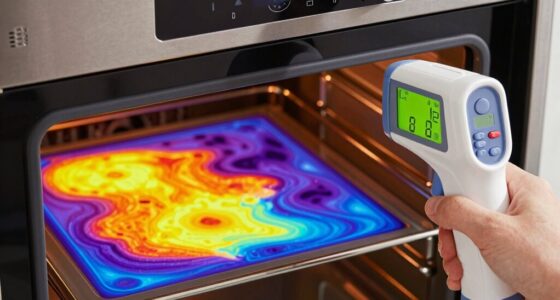
If you’ve ever baked a cake only to find it domes in the middle, you’re not alone. That perfect, level cake can seem elusive, but understanding why it happens is the first step to preventing it. One common cause is an oven temperature that’s too high. When your oven runs hotter than the recipe calls for, the outside of the cake sets and rises quickly, while the inside struggles to catch up. This rapid rise creates a dome as the center pushes upward before the batter has fully baked through. To avoid this, always double-check your oven’s temperature with an oven thermometer and stick to the recommended setting. If your oven tends to run hot, consider lowering the temperature slightly and adjusting your baking time accordingly.
A high oven temperature causes quick outside setting and doming; use an oven thermometer to keep it in check.
Another key factor is batter consistency. If your batter is too thick or too thin, it can influence how evenly your cake rises. A batter that’s too thick resists expansion, forcing the center to lift more dramatically once it heats up. Conversely, a batter that’s too thin might rise too quickly and then collapse, creating an uneven dome. Aim for a smooth, pourable consistency—similar to thick pancake batter. This helps guarantee even heat distribution and consistent rising. Properly mixing your ingredients and not overmixing the batter are essential here, as overmixing can develop gluten, leading to a denser batter that behaves unpredictably during baking. Incorporating proper mixing techniques can further help achieve the ideal batter texture. Additionally, using accurate measuring tools ensures your ingredients are balanced correctly, which is crucial for proper rise and texture.
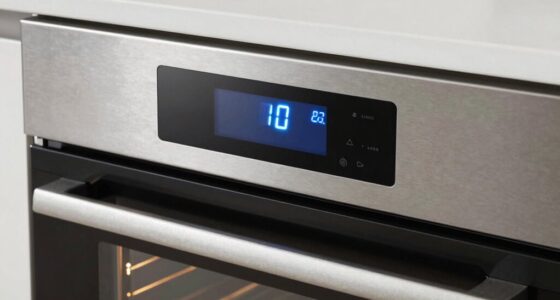
In addition, how you prepare your cake pan can influence the final shape. Greasing and flouring the pan or using parchment paper helps prevent uneven heat transfer, which can contribute to doming. Also, avoid opening the oven door too early or too often during the first half of baking. Sudden temperature drops can cause the cake to sink or dome unexpectedly because the batter’s structure is disrupted. Using an oven light to monitor your cake helps prevent this. Additionally, ensuring proper oven calibration with a reliable thermometer can help maintain consistent baking conditions. To further support even baking, consider adjusting oven racks to optimize heat circulation around your cake. Furthermore, understanding oven hot spots**** in your oven can help you position your cake more effectively for even baking.
Finally, consider the placement of your cake in the oven. Centering the pan on the middle rack ensures even heat exposure. If your oven has hot spots, rotating the cake halfway through baking can help promote uniform rising. Paying attention to all these details—oven temperature, batter consistency, pan preparation, and baking techniques—will greatly reduce the chances of that unwanted dome. With careful adjustments, your cakes will come out level, baked evenly, and ready to impress every time.

AcuRite 00620A2 Stainless Steel Oven Thermometer (150°F to 600°F)
Oven and grill safe for leave-in use while cooking
As an affiliate, we earn on qualifying purchases.
As an affiliate, we earn on qualifying purchases.
Frequently Asked Questions
Can Oven Rack Placement Affect Cake Doming?
Yes, oven rack placement can affect cake doming. If you place the rack too high or low, uneven heat distribution may cause the center to rise faster, leading to doming. To prevent this, make certain your oven is properly calibrated, and position your rack in the middle. Also, use cooling techniques like an even cooling rack to help your cake settle evenly, reducing the risk of doming.
Does Cake Pan Material Influence Dome Formation?
Like a sponge soaking up water, your cake pan material impacts doming. Metal pans conduct heat quickly, encouraging even baking, while glass or ceramic pans insulate, causing the center to heat slower and rise more. Non-stick coatings can also influence heat distribution slightly. To prevent doming, choose pans with good heat conduction and consider oven insulation, which helps maintain consistent temperature. This way, your cake bakes evenly without a dome.
How Does Batter Consistency Impact Rising?
Your batter’s viscosity greatly impacts how it rises. If it’s too thick, it won’t expand evenly, causing domes, while a too-thin batter may rise too quickly and then collapse. Use proper mixing techniques to achieve the right consistency—combine ingredients just until smooth, avoiding overmixing. By controlling batter viscosity, you guarantee even rising, resulting in a flatter, more uniform cake without unwanted domes.
Is It Better to Bake With Convection or Conventional Heat?
You should bake with conventional heat for cakes focused on flavor and frosting techniques. Convection ovens circulate hot air, which can cause uneven rising and affect the cake’s texture, making it harder to achieve a smooth crumb ideal for frosting. Conventional heat provides gentler, more even baking, helping your cake develop a consistent crumb and flavor. This way, your frosting techniques will turn out flawless, and your cake will look professional.
Can Using Baking Strips Prevent Doming?
Using baking strips can help prevent doming by promoting even heat distribution, which supports better cake leveling. While some believe they solely prevent cracks, studies show they also keep the batter’s thickness consistent, reducing uneven rising. Proper batter thickness and even heat are key, and baking strips are a simple tool to achieve a flatter, more level cake. They’re especially helpful for cakes that tend to dome despite other adjustments.
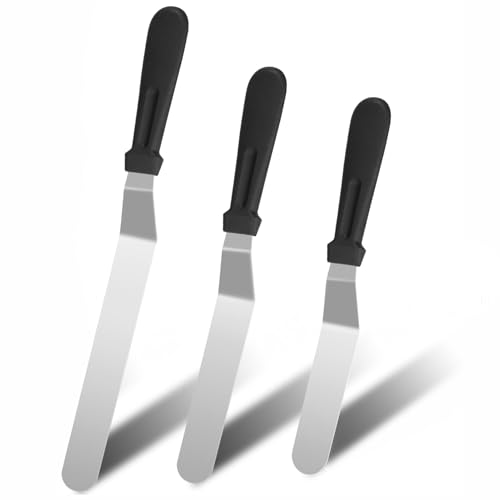
3 PCS Icing Spatulas, Offset Spatula, Stainless Steel Cake Decorating Spatulas Set 6/8/10 inch Professional Angled Cake Spatula Plastic Frosting Handle for Home, Kitchen or Bakery by XEKIGU
【MULTIPLE SIZES] Icing spatula set comes in four different sizes 6, 8, 10 inches for different applications. It's…
As an affiliate, we earn on qualifying purchases.
As an affiliate, we earn on qualifying purchases.
Conclusion
Understanding why your cakes dome in the middle is like solving a tricky puzzle—you just need to know where to look. By adjusting your oven temperature, properly mixing your batter, and avoiding overbaking, you can achieve a perfectly level cake every time. Think of it as nurturing a delicate flower; with the right care, it blooms beautifully. So, don’t be discouraged—your perfect cake is just a few tweaks away, waiting to impress everyone at your next bake sale.

HIWARE Springform Pan Set of 3 Non-stick Leakproof Round Cake Pan Set Includes 3 Pieces 6" 8" 10"
PERFECT FOR MAKING ALL YOUR FAVORITES like cheesecake, mousse, quiche, coffee cake and any similar recipe where you…
As an affiliate, we earn on qualifying purchases.
As an affiliate, we earn on qualifying purchases.

Cupcake Batter Dispenser Scoop with One-Touch Sliding Button – Professional Cake Batter Distribution Tool for Kitchen Baking – Easy Clean Pastry Batter Scoop for DIY Cupcakes & Pancakes
Drip-Free Precision: Features a unique curved edge and plunger design that ensures clean, precise batter dispensing without messy…
As an affiliate, we earn on qualifying purchases.
As an affiliate, we earn on qualifying purchases.