
TL;DR

Get kitchen gear delivered free with Prime
- Fast, free delivery on millions of items
- Prime Video, Amazon Music and more included
- Member-only deals all year
Air fryers for winter cooking are handy for crisp vegetables, small portions, chicken, fish, and reheated leftovers because they heat up quickly and do not require warming a full-size oven. Cut ingredients evenly, leave room for airflow, and treat recipe times as a guide; an air fryer complements rather than replaces an oven, especially when you are feeding a crowd.
When it’s dark before dinner and your kitchen already feels chilly, waiting for a full oven to heat can make a simple meal feel like a project. An air fryer gets hot quickly and can turn a small batch of potatoes or Brussels sprouts golden without filling a large oven with heat.
That makes air fryers for winter cooking appealing for weeknight sides, one- or two-person dinners, and leftovers that deserve their crisp edges back. They’re not magic, though: basket size, airflow, and the food itself affect the result, and a full-size oven still makes more sense for a big roast or several trays at once.
This guide shows you what to cook, how to get better browning, and where an air fryer fits into a cold-weather kitchen. You’ll also get practical safety and food-checking tips, so dinner comes out comforting—not undercooked or uneven.
Use an air fryer for small winter meals and sides; choose a full-size oven for big roasts or several trays.
Cut dense vegetables into similar-sized pieces and leave gaps so hot air can reach their surfaces.
Treat preset and recipe times as guides: turn or shake food, check early, and verify meat and poultry with a thermometer.
Use a little oil to help fresh vegetables brown, but never pour oil into the appliance.
Check your manual for ventilation, parchment or foil use, cleaning, and safe handling.
Why an air fryer feels handy on a cold weeknight
Air fryers for winter cooking work especially well when you want a small meal or side without heating a full-size oven. Their fan moves hot air around food, and many models need little or no preheating, so you can get dinner started quickly on a cold evening. That quick heat-up suits a couple of baked potatoes or a tray-sized portion of vegetables far better than it suits a holiday feast.
There’s a useful before-and-after difference: instead of waiting for a large oven to warm while your fingers are still cold from coming in, you can load the basket with a modest batch and start cooking. A fan helps brown the outside, creating crisp edges on potatoes or sprouts, though the result is not identical to deep-frying. A small drizzle of oil can help fresh vegetables brown; it won’t guarantee a shattering fried crust.
Air fryers can be especially useful for one or two servings, reheating a side, or cooking while another dish occupies the oven. For example, roast a small portion of carrots while a casserole bakes, then serve them with their edges dark and sweet. If you’re making dinner for six, however, several basket loads may take longer and demand more attention than one oven tray.
The practical win is scale: an air fryer makes modest portions convenient, but its basket is not a tiny substitute for unlimited oven space.
How warm the kitchen gets depends on your appliance, cooking time, and what you would otherwise run. An air fryer uses a smaller cooking space, but that alone does not prove it always uses less energy. Think of it first as a convenient tool for small batches, not a guaranteed utility-bill fix.
Products Worth Considering

Instant Pot Vortex Plus 6-Quart 6-in-1 Air Fryer

Cuisinart TOA-70NAS Air Fryer Toaster Oven with Grill

Cuisinart SM-50R 5.5-Quart Stand Mixer, Ruby Red
As an affiliate, we earn on qualifying purchases.
Which winter foods come out golden and satisfying
Air fryers for winter cooking are a strong match for potatoes, carrots, squash, parsnips, cauliflower, and Brussels sprouts because hot circulating air can brown their surfaces while the centers soften. Cut the pieces into similar sizes and leave gaps between them; otherwise, the outside pieces may darken while crowded pieces turn limp. That simple preparation makes a real difference on a plate beside roast chicken.
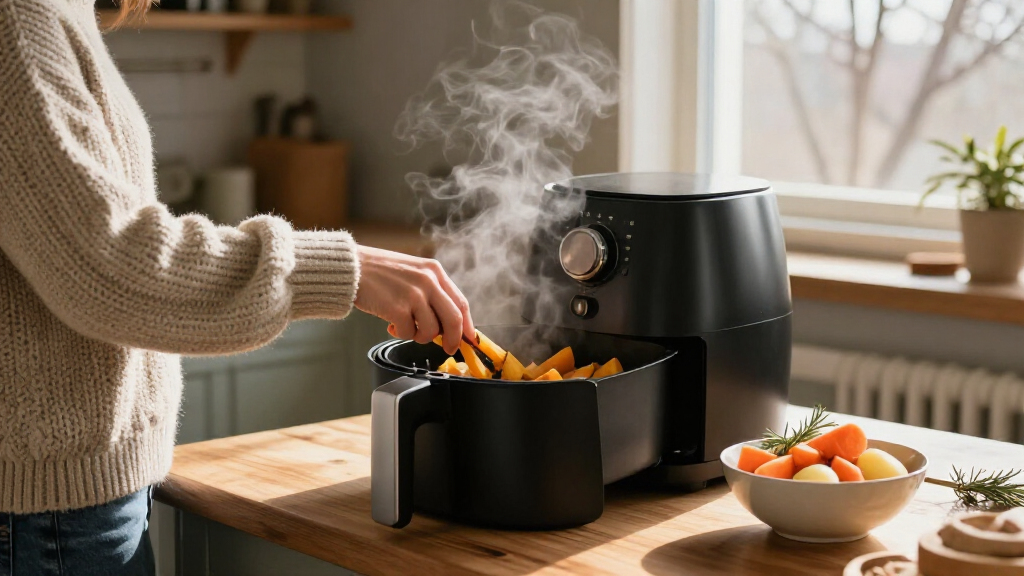
For an easy side, cut carrots and parsnips into sticks of roughly similar thickness, toss them with a little oil and seasoning, then cook in a single, uncrowded layer. Shake or turn them partway through. Exact timing depends on the appliance and cut size, so begin checking early rather than treating a recipe’s minutes as a promise. You want tender centers and browned corners, not blackened tips.
Other useful choices include chicken pieces, fish fillets, and small frozen snacks. A fish fillet can cook quickly, while thicker cuts need careful checking; use a food thermometer for meat and poultry and follow safe cooking guidance. Frozen foods often go straight into the basket, but check the package directions and verify that the center is fully cooked.
Small-batch baking can work too. Imagine a cold Sunday afternoon and a few apple slices with cinnamon, or a modest portion of baked fruit for two. Results differ between air fryer designs, so use a recipe written for your style of appliance when possible, and keep an eye on delicate items that can dry or brown fast.
- Root vegetables: cut evenly and cook in batches if needed.
- Sprouts and cauliflower: dry the surfaces and give them room to brown.
- Chicken and fish: check doneness rather than relying on color alone.
- Frozen snacks: follow package directions and confirm they are hot throughout.
How to get crisp results instead of a crowded, soggy basket
For crisp winter food, keep the basket loose, dry the ingredients, and turn or shake them as they cook. Air needs room to move around each piece; when you pile vegetables into a dense mound, moisture collects and browning becomes uneven. In other words, a smaller batch often beats a fuller basket if crisp edges are what you want.
- Cut pieces to a similar size. A carrot coin and a thick chunk of squash will not soften at the same pace. Uniform pieces help dinner finish together.
- Dry ingredients before seasoning. Pat damp vegetables with a clean towel so surface moisture doesn’t work against browning.
- Add a little oil only when useful. A light coating can help fresh vegetables brown. Follow your appliance manual, and don’t pour oil into the unit.
- Arrange food with gaps. If you have to stack it tightly, cook in batches instead.
- Shake, turn, and check early. Appliance design and food thickness change the timing; look for the texture and doneness you need.
Say you’re cooking a full basket of Brussels sprouts for a weeknight dinner. The sprouts pressed against one another may come out soft, while the ones near the edge get dark. Split them into two batches, shake each once, and the second round will likely brown more evenly. That small pause is often worth it.
If food still lacks color, check for excess moisture, crowding, and whether you have given it enough time. Don’t compensate by cranking up the heat without checking the food: small pieces can scorch quickly. A recipe is a starting point, not a substitute for looking, turning, and testing.
When an air fryer beats the oven—and when it doesn’t
An air fryer is usually more convenient than a full-size oven for a small batch, while an oven is generally a better fit for large trays, big roasts, and meals for a crowd. The right choice depends on portion size, your model’s capacity, and whether several foods need to cook at once. For a solo dinner, the air fryer may feel nimble; for a family roast with vegetables and potatoes, the oven has room to spare.
| Cooking job | Air fryer | Full-size oven |
|---|---|---|
| One or two portions | Convenient for quick sides or a small main. | May be more space and heat than you need. |
| Several trays at once | Limited by basket or rack space; batches may be needed. | Usually better for cooking multiple dishes together. |
| Reheating crispy food | Can restore crunch to pizza, potatoes, or breaded items. | Useful for larger quantities, though it may take longer to heat. |
| Soft leftovers | Can dry out delicate foods if heated too long. | May warm covered dishes more gently. |
Picture a Tuesday night: you have one portion of roasted potatoes and a slice of pizza. The air fryer can bring back browned edges more effectively than a microwave, which tends to make crust and breading soft. But a bowl of delicate pasta may dry out in the basket, so gentle reheating by another method could suit it better.
Models vary. Basket designs, dual-basket units, and oven-style air fryers offer different capacities and layouts, while presets provide only a starting time. A larger model may be useful if you regularly cook for several people, but it also needs counter space and room around its vents. Compare the real size of your usual meals—not just the appliance’s feature list—before deciding which style fits your winter routine.
How to fit air-fryer cooking into a safer winter kitchen
Use an air fryer safely by giving it ventilation space, following the manufacturer’s instructions, and checking the food rather than trusting a preset alone. The unit releases hot air, and winter kitchens often have more appliances crowded onto the counter. Before you start, set it on a stable surface with the clearances specified in its manual, away from items that could block vents.
For meat and poultry, use a food thermometer and follow food-safety guidance for the cut you’re cooking; a browned exterior does not prove the center is ready. This matters with thick chicken pieces, especially when a cold-weather dinner is underway and everyone is hungry. Check the thickest part and allow for variation in appliance power, piece size, and whether food started frozen.
Use foil or parchment only if your manufacturer allows it and you can keep it from blocking airflow or touching the heating element. Never preheat with loose parchment in the basket: the fan can lift it toward the hot element. Let the appliance cool before cleaning, then wash the basket and tray according to the manual; avoid abrasive tools and don’t immerse electrical parts unless the maker specifically says they are safe to wash.
After a roast-vegetable dinner, for instance, let the basket cool enough to handle, then remove crumbs and grease before they build up. That routine helps keep the appliance clean and ready for tomorrow’s potatoes. If the manual gives different guidance for your model, follow it. Presets, washable parts, and safe clearances are not identical across every machine.
Safety shortcut: use the manual for appliance rules and a thermometer for meat doneness. A recipe time cannot replace either one.
How to build an easy winter dinner around one basket
Build a simple air-fryer dinner by choosing one main or side that fits the basket, preparing evenly sized pieces, and planning another cooking method for anything that needs more room. This keeps a comforting meal realistic instead of turning a small appliance into a one-basket traffic jam. Think crisp potatoes with a pan of soup, or browned vegetables beside chicken cooked in a separate batch.
Try this on a dark Wednesday: cut a couple of potatoes into similar wedges, pat them dry, add a light coating of oil and seasoning, then cook them with room between pieces. Shake the basket during cooking and check for a tender middle and golden edges. If you also want chicken, cook it separately or use a suitable model with enough capacity; use a thermometer to check it is done.
Meanwhile, warm a pot of soup on the stove. The air fryer handles the crisp part, while the stovetop handles the liquid part. This combination brings the pleasure of a hot, hearty meal without asking one appliance to do everything. If you’re cooking for more people, make the air fryer one part of a larger plan rather than repeatedly squeezing extra food into the basket.
A dual-basket or oven-style model can make coordination easier, but extra features don’t erase the need to check food and avoid crowding. Presets, roasting modes, or multiple racks are convenient starting points; food size and load still affect timing. Keep your first few attempts simple, note what works in your own appliance, and adjust the next batch based on how it actually browned.
Frequently Asked Questions
Can an air fryer replace my oven in winter?
Not completely. An air fryer is convenient for small meals, sides, and crisp reheating, while a full-size oven is usually more practical for large roasts, big trays, or cooking for a crowd.
Does an air fryer heat the kitchen less than an oven?
It cooks in a smaller space and may feel more comfortable than running a large oven for one modest portion. Actual energy use depends on the appliance, cooking time, and what you are replacing, so the difference is not the same in every kitchen.
What winter vegetables work well in an air fryer?
Potatoes, carrots, parsnips, squash, Brussels sprouts, and cauliflower are common choices. Cut them to similar sizes, dry their surfaces, and avoid packing the basket tightly so they can brown more evenly.
Can I put frozen food straight into an air fryer?
Many frozen foods can cook from frozen, but timing and results vary by product and appliance. Follow the package directions and check that the food is fully cooked throughout.
Why aren’t my air-fryer vegetables getting crispy?
Common causes include a crowded basket, wet ingredients, or not turning the food. Pat vegetables dry, cook in smaller batches, and check them during cooking; a little oil can help fresh produce brown.
Can I use foil or parchment in an air fryer?
Only when the appliance manufacturer allows it and you can use it without blocking airflow. Keep loose paper away from the heating element, and never preheat with loose parchment in the basket.
Conclusion
Use your air fryer for the jobs it handles well: a quick portion, a crisp winter side, or leftovers that need their crunch back. Keep batches loose, check doneness, and bring in the oven or stovetop when the meal outgrows the basket.
On the next cold evening, let a handful of golden potatoes do their quiet work: warming the plate, crisping at the edges, and making dinner feel a little less like a chore.