TL;DR

Get kitchen gear delivered free with Prime
- Fast, free delivery on millions of items
- Prime Video, Amazon Music and more included
- Member-only deals all year
A professional sheet pan set with wire racks pairs a rimmed baking pan with a raised rack for cooling, roasting, crisping, or catching drips. To choose a replacement, compare the pan’s outside dimensions and depth, confirm that the rack fits inside it, check materials and coatings, and verify the oven’s maximum temperature. Among the alternatives described here, Wildone most closely matches the original’s stated pan and rack materials and near-identical dimensions, while the other sets differ in size, coating, or available specifications.
A pan that barely misses your oven rack can turn a simple roast into a game of kitchen Tetris. If you’re replacing a professional sheet pan set with wire racks, matching the familiar name or general “half sheet” label won’t tell you whether the pan will fit your oven, whether its rack sits securely, or whether its surface suits your cooking.
This guide explains how to compare the original Commercial Quality set’s listed specifications with four alternatives. You’ll learn which details to check before buying, how pan and rack materials affect everyday use, and where the available product information leaves questions unanswered.
Measure your oven rails and compare them with the pan’s outside dimensions; “half sheet” alone does not prove a fit.
The original pan is listed at 18 × 13 × 1.05 inches, while the Wildone pan is 17.32 × 12.99 × 1.06 inches.
Wildone is the closest listed match for pan size and construction, but its stated rack material is steel rather than stainless steel.
The four-pan alternative has a listed 446°F / 230°C maximum; check recipe temperatures against the product’s stated limit.
Confirm rack fit, set contents, care instructions, and any missing oven limits in current manufacturer information.
Know what a professional sheet pan set with wire racks does
A professional sheet pan set with wire racks combines a rimmed baking pan and one or more raised metal grids, giving you a flat surface for baking and a lifted surface for cooling or cooking. The pan catches crumbs and drips; the rack lets air move around food. Together, they work like a small, flexible stage in your oven or on your counter.
That simple pairing covers several jobs. You can cool a batch of chocolate chip cookies without trapping steam underneath, roast chicken pieces above the juices, or set a rack over the pan to crisp breaded cutlets. On a busy Sunday, the same pan can hold roasted vegetables while its rack cools a tray of warm biscuits nearby.
The original Commercial Quality set is described as including two 18 × 13-inch pans and two stainless steel racks. Its pan is listed at 1.05 inches deep, with aluminum construction and a reinforced steel rim. Those specifics give you useful comparison points, though the product’s current status is not certain from the information available.
“Half sheet” is a useful size label, but it doesn’t replace a tape measure. Manufacturers may list outside dimensions, and even small differences can matter if your oven rails are narrow or a pan needs to sit beside another. Measure the usable width and depth of your oven before you shop.
Compare the four alternatives by the details they actually list
The closest match depends on which original specifications matter most to you: the pan size, material, rack material, coating, temperature limit, or set contents. In the comparison below, “not specified” means the product information supplied for this guide does not state that detail, so check the manufacturer’s current listing or instructions before relying on it.
| Set | Listed pan size | Materials or coating | Temperature | What is listed in the set |
|---|---|---|---|---|
| Commercial Quality original | 18 × 13 × 1.05 in. | Aluminum pan, reinforced steel rim; stainless steel rack; uncoated | 500°F / 260°C | Two pans and two racks |
| Wildone Half Sheet Pans and Cooling Racks, Set of 4 | 17.32 × 12.99 × 1.06 in. | Aluminum pan with reinforced steel rim; steel rack | Not specified | Product name identifies a set of four; check the listing for exact contents |
| Chicago Metallic Jelly Roll Pan Set with Cooling Rack | 16 × 12 × 2 in. | Silicone-based nonstick coating; other listed materials not specified | Not specified | Pan and cooling rack |
| Set of 4 Baking Pans with Cooling Racks | 16 × 11 × 1 in. | Not specified | 446°F / 230°C | Product name identifies four pans with racks; check exact quantities in listing |
| Hestan Provisions OvenBond 12 × 15-Inch Stainless Steel Sheet Pan and Rack Set | 12 × 15 in. in product name | Stainless steel in product name; other construction details not specified | Not specified | One medium sheet pan and rack |
Wildone is the nearest listed size-and-material match: its pan differs from the original by 0.68 inch in length and 0.01 inch in width, and both are described as aluminum with reinforced steel rims. Its rack is described as steel, while the original’s is stainless steel. The provided information does not list Wildone’s maximum oven temperature.
The other choices serve different priorities. Chicago Metallic lists a smaller 16 × 12-inch pan with a silicone-based nonstick coating, while the 16 × 11-inch set supplies a stated 446°F limit. Hestan’s named 12 × 15-inch size is smaller than the original, and the supplied details identify a medium pan and rack without a listed temperature limit.
Measure your oven and check the rack before you choose
To choose a professional sheet pan set with wire racks that fits your kitchen, measure the oven’s usable interior and compare it with the pan’s full outside dimensions. A nominal size can hide a tight fit, and a pan that slides into the oven still needs room for hot air to circulate around it.
- Measure the oven rails. Check the width between the sides and the depth from the door to the back wall. Leave room for the pan to slide in without scraping or catching.
- Compare the pan’s outside dimensions. Look for length, width, and depth, not just “half sheet.” If you have a compact oven, compare each measurement with your current pan.
- Check the rack’s fit. Confirm that the rack sits inside the pan without rocking, bowing, or resting on the rim. If the listing doesn’t provide rack dimensions, look for a manufacturer diagram or ask the seller.
- Match the set contents to your routine. If you roast vegetables and bake cookies at the same time, two pans and two racks may save a wash-and-wait cycle. If you only cool cakes now and then, one pan-and-rack pair may be enough.
- Verify the oven limit and care instructions. Use the lowest stated maximum temperature among the pan, rack, coating, and any included accessories. Check whether the maker allows a dishwasher, metal utensils, or broiler use.
Imagine your oven opening is 17 inches wide. The original’s listed 18-inch length may be too large if that dimension has to span the opening, while the Wildone’s 17.32-inch length still may be a snug fit depending on how the manufacturer measured it. Measure the actual rails and the pan’s outside edges rather than guessing from the label.
Fit the pan to your oven, then the rack to the pan. A rack that shifts under a hot tray of chicken can spill drippings, so check that it rests flat and securely before cooking.
Choose pan and rack materials for the way you cook
Material affects how a pan heats, how it responds to care, and how long it keeps its finish. The original set lists an aluminum pan with a reinforced steel rim and an uncoated surface. That combination gives you a concrete baseline when comparing replacements, but the supplied details do not establish that every alternative uses the same construction.
Aluminum pans are common because they conduct heat well, which can help food brown evenly across a broad surface. A reinforced rim can add stiffness, useful when you lift a pan loaded with potatoes or a bubbling fruit crisp. Still, pan thickness and construction vary; the material name alone won’t tell you exactly how a specific pan performs.
Stainless steel and steel racks lift food above the pan so hot air can move around it. For cooling, that airflow helps steam escape instead of leaving a cookie’s underside damp. For roasting, the rack can separate food from rendered fat, though you may prefer direct pan contact when you want vegetables to brown in their own juices.
Rack material names deserve a careful read. The original lists stainless steel, and Wildone lists steel. Since the information provided doesn’t explain the precise alloy or care instructions for every item, don’t assume that similarly named materials have identical rust resistance or cleaning needs. Dry a rack promptly if its maker recommends hand washing.
Here’s a practical example: if you often roast bacon or chicken wings, a rack that fits firmly over a rimmed pan can hold the food above grease while the pan catches the drips. If you mainly bake cookies, you might use the rack on the counter for cooling and put the pan away. The right material choice depends on which of those jobs you do most.
Decide whether nonstick or uncoated suits your recipes
A nonstick coating can make delicate foods release more easily, while an uncoated pan gives you a bare surface and avoids coating-specific care. The original set is listed as uncoated; Chicago Metallic’s Jelly Roll Pan Set is listed with a silicone-based nonstick coating. The supplied specifications don’t identify a coating for the other alternatives.
For sticky maple-glazed carrots or roasted tomatoes, nonstick may make cleanup easier. But a coating usually comes with care rules, such as avoiding abrasive scrubbers or sharp utensils. Read the product instructions before using metal tools or placing a coated pan under a broiler.
An uncoated surface has its own tradeoffs. Parchment paper can help with cookies, while a light film of oil can help roast vegetables release. A plain pan may develop discoloration with use; cosmetic changes don’t necessarily mean it has failed, but follow the maker’s guidance for cleaning and safe use.
Consider a weeknight batch of granola. A coated pan could help keep honey-bound oats from sticking, but if the recipe calls for high heat, you need to check the coating’s temperature limit first. The provided Chicago Metallic specifications don’t state a maximum temperature, so verify that limit with the current manufacturer information before using it for that recipe.
- Choose a coated pan if easy release and quick cleanup matter most, and you’re comfortable following coating care instructions.
- Choose an uncoated pan if you want a bare cooking surface and are happy to use parchment, oil, or a little extra scrubbing.
- Check temperature limits for the complete setup, including any coating and rack, before high-heat roasting or broiling.
Use the rack to cool, roast, and crisp more effectively
A wire rack turns one pan into a small workhorse: it can cool baked goods, lift food for roasting, and keep crisp items from sitting in moisture. The best setup changes with the recipe. For cookies, the rack belongs on a stable counter; for oven roasting, it belongs inside a compatible pan.
To cool cookies, move them from the baking sheet to the rack after they have set enough to handle. Leave a little space between each one so air can pass through. A warm cookie placed directly on a flat plate can trap steam underneath, softening the bottom before the chocolate chips have lost their shine.
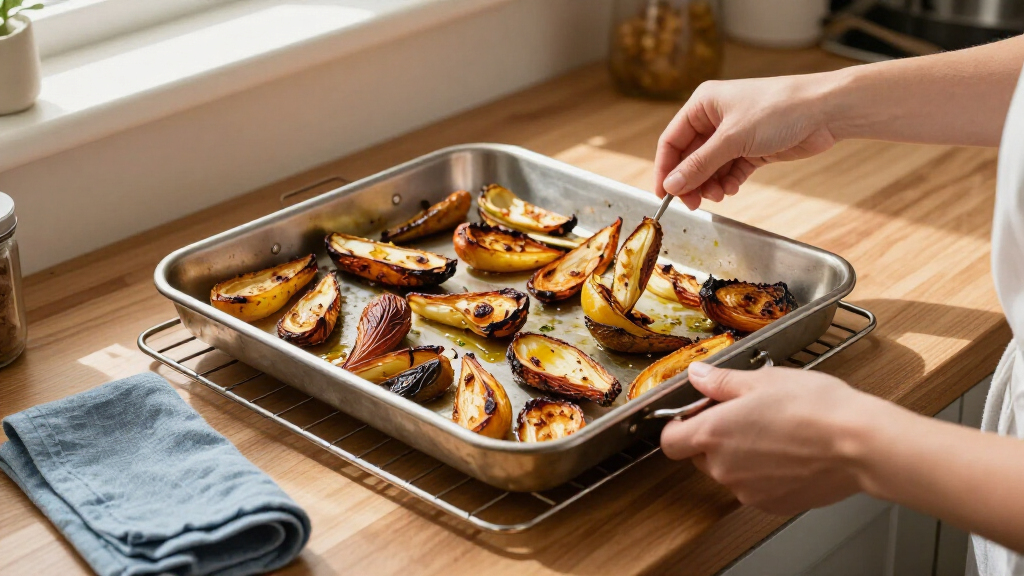
For roasting, place the rack inside the pan and spread food in a single layer. A crowded tray makes vegetables steam and soften instead of browning, even with a rack underneath. Try chicken thighs spaced apart over a rack, with the pan below to catch juices; check that the food and rack stay stable when you slide the assembly in.
For crisping, airflow helps, but it doesn’t replace proper cooking. Breaded fish or reheated fries can shed crumbs and oil, so a rimmed pan beneath the rack catches the mess. Turn food if your recipe calls for it, and follow the cooking temperature and doneness guidance for the food itself.
Think of the rack as a little bridge: it raises food above moisture while the pan below handles the runoff. A rack works best when it sits level and leaves enough space for air to move. If it wobbles, bends under the food, or presses against the pan walls, choose a better-fitting combination.
Check temperature, care, and construction before checkout
A pan’s temperature limit tells you the highest oven heat its maker specifies, but the rack, coating, and included parts may have different limits. The original set is listed at 500°F / 260°C, and the four-pan alternative is listed at 446°F / 230°C. The supplied information does not state maximum temperatures for Wildone, Chicago Metallic, or Hestan.
That difference matters when a recipe calls for a very hot oven. If you regularly roast vegetables at 450°F, the 446°F-listed set falls below that recipe temperature; you’d need to check whether the recipe can be adjusted or choose a pan with a suitable maker-stated limit. Never treat a missing temperature specification as permission to use any heat.
Care instructions can also decide whether a set feels convenient. Some makers allow dishwasher cleaning; others recommend hand washing to protect a coating or finish. A rack’s tight corners can hold baked-on oil, so soaking it in warm soapy water may help loosen residue, but follow the manufacturer’s instructions for the exact product.
Look closely at the construction details. A reinforced rim can make a large pan easier to handle, and exact rack dimensions help confirm a secure fit. If the listing omits a measurement or care rule that matters to you, check the maker’s product documentation before relying on a retailer summary.
For example, if you plan to roast salmon at 425°F and use parchment, a pan with a stated limit above that temperature and clear parchment guidance gives you more certainty. If you also want to broil vegetables, verify broiler approval separately; an oven-safe temperature number alone does not automatically answer that question.
Match each alternative to a real kitchen need
The best replacement depends on the job you need it to do and the facts you can confirm. Based on the specifications provided, Wildone most closely matches the original’s listed dimensions and aluminum pan construction. Chicago Metallic offers a smaller coated option, while the other two alternatives have different pan sizes or a more limited set of matching details.
Pick Wildone for the closest listed size-and-material match. Its 17.32 × 12.99 × 1.06-inch pan is close to the original’s 18 × 13 × 1.05-inch pan, and both descriptions name aluminum with a reinforced steel rim. If you need the closest match to the rack material too, note that one listing says steel and the other says stainless steel; confirm the fit and care details before deciding.
Look at Chicago Metallic if a coated, smaller pan fits your routine. Its listed dimensions are 16 × 12 × 2 inches, with a silicone-based nonstick coating. That deeper shape may suit some jelly roll recipes, but it differs from the original’s 1.05-inch depth. Check its oven limit and rack dimensions with the manufacturer because those details aren’t included here.
Consider the four-pan set if the 446°F limit and 16 × 11-inch size work for you. Its listed maximum temperature is 446°F / 230°C, so it may not suit recipes that require higher heat. The supplied information doesn’t name the pan or rack materials, which leaves more to verify before you buy.
Choose Hestan only if its 12 × 15-inch format suits your oven and tasks. The product name identifies a stainless steel sheet pan and rack set, with one medium pan and rack listed. It’s notably smaller than the original’s 18 × 13-inch pan; the provided specifications do not give a temperature limit or further construction details.
Suppose you bake cookies for a family gathering and roast vegetables on the same evening. Two similarly sized pans and racks may save time because you can cool one batch while the next cooks. If you have a narrow countertop oven, a smaller set may be more practical, even when it matches fewer of the original’s specifications.
Keep these four checks in mind as you shop
A good replacement choice starts with fit and ends with the details that affect your cooking. You don’t need every set to match the original in every way; you need the dimensions, materials, and care rules that suit the food and oven you use.
- Measure the oven opening and rails, then compare them with the pan’s outside length, width, and depth.
- Confirm that the rack nests securely inside the pan and won’t rock when loaded.
- Check material, coating, and temperature limits for the pan and rack as a complete setup.
- Verify the exact set contents and care instructions in current manufacturer information, especially if the product description leaves details blank.
For a shopper replacing the original Commercial Quality set, Wildone is the clearest starting point in the supplied comparison because its listed size and pan construction are close. The final choice still depends on fit, rack material, temperature rating, and the exact items included in the current listing.
Frequently Asked Questions
What size is the original Commercial Quality sheet pan?
The pan is listed as 18 × 13 × 1.05 inches. Measure your oven and the pan’s outside edges before choosing a replacement, since dimensions and “half sheet” labels can vary.
Which listed alternative is closest to the original?
Wildone has the closest listed pan dimensions and construction: its pan measures 17.32 × 12.99 × 1.06 inches and is described as aluminum with a reinforced steel rim. Its rack is listed as steel, while the original rack is listed as stainless steel, so check the details that matter to you.
Can I use a sheet pan rack in the oven?
Use a rack in the oven only when its maker specifies that it is oven-safe at your cooking temperature. Confirm that the rack fits securely inside the pan and check any coating or care limits before roasting.
Is an uncoated or nonstick sheet pan better?
Neither works best for every kitchen. An uncoated pan gives you a bare surface, while a nonstick coating can make some foods easier to release; follow the maker’s utensil, cleaning, and temperature instructions for either type.
What should I check if a product listing leaves out the temperature limit?
Check the manufacturer’s current product information for the pan, rack, and coating before using high heat. A missing specification does not confirm that the set can handle a particular temperature or broiler setting.
Conclusion
Start with a tape measure, then compare rack fit, materials, coating, and the full set of temperature limits. A close match on paper only helps if the pan slides into your oven and the rack sits steady beneath your food.
Choose the set that fits your oven and your weeknight habits; then let that sturdy pan catch the drips while dinner turns golden.
Fall Picks
fall essentials
As an affiliate, we earn on qualifying purchases.