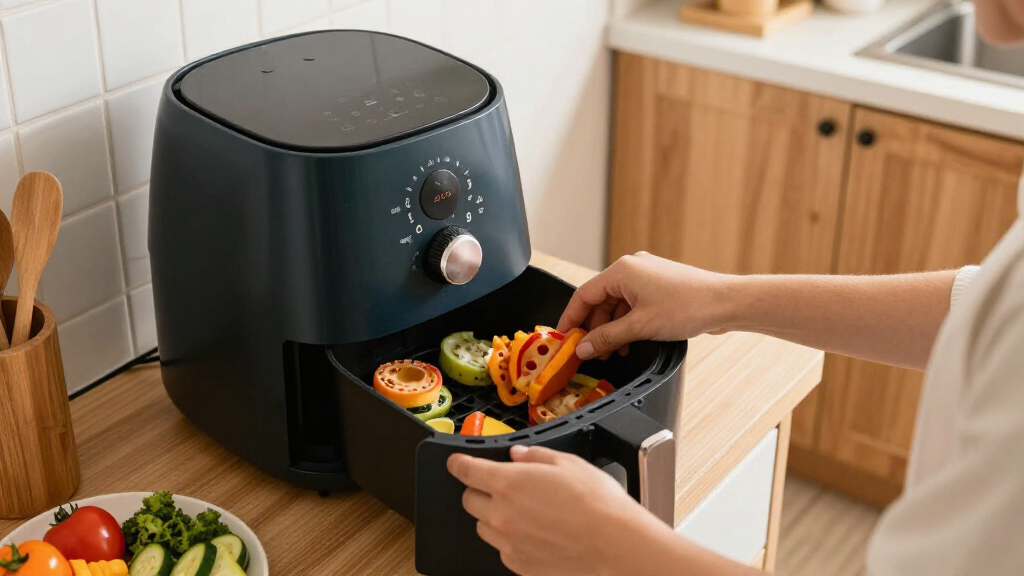
Counter space is the deciding factor when shopping for air fryers for small kitchens, and the real tradeoff is capacity versus footprint: a 5-quart basket cooks a full meal but hogs the counter, while a 2-quart mini frees up space but won’t feed more than one or two people. The Ninja Air Fryer Pro 5-Quart (AF141) earns my best overall pick because it delivers full-size performance in a footprint barely larger than the 4-quart competition. For truly tight spaces, the COMFEE’ 2.1-Quart Mini is the best value at a fraction of the price, and the Ninja Crispi Glass stands out for renters who want cookware-style versatility without a permanent counter presence. Noise levels, basket shape, and whether controls are digital or dial-based separate the top picks more than raw wattage does. Keep reading for the full ranked breakdown, including which models I’d skip despite the hype.
Complete the kit


Key Takeaways
- The Ninja Air Fryer Pro AF141 won best overall because its 5-quart capacity fits in roughly the same footprint as most 4-quart models — the best capacity-per-square-inch ratio in this lineup.
- Every 2-quart-class model here (COMFEE’, Cosori Lite, CHEFMAN 2 Qt) struggled with the same limitation: a single chicken breast plus vegetables maxes them out, making them poor choices for couples despite their tiny price tags.
- The Ninja Crispi Glass is the only pick that solves the storage problem rather than the counter problem — its glass dishes double as storage, which matters if your kitchen has zero permanent counter space.
- Touchscreen models like the Chefman 4-Qt and DUMOS 3-Qt cost more than dial-based rivals but add little practical benefit at this size; the money is better spent on basket coating quality.
- The Cosori TurboBlaze 6-Qt is the largest model in this roundup and only makes sense for small kitchens with deep cabinets — its capacity beats every other pick, but it demands more counter real estate than anything else here.

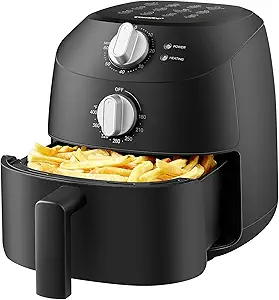


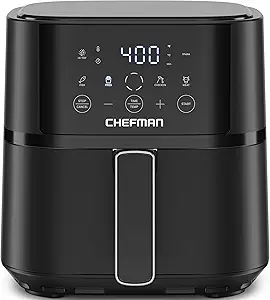


| air fryers for small kitchen | Capacity | Controls |
|---|---|---|
| Ninja Air Fryer | 4 quarts | Dial-based |
| COMFEE’ Compact 2.1-Quart Mini | 2.1 quarts | Push button |
| Ninja Air Fryer Pro | 5 quarts | — |
| DUMOS 3 Qt Air Fryer | 3 quarts | Digital |
| Chefman Air Fryer | 4 quarts | Touchscreen |
| Cosori TurboBlaze Air Fryer | 6 quarts | — |
| Dash Tasti-Crisp Air Fryer | 2.6 quarts | Adjustable temperature and timer |
| Newbulig 3 Qt Air Fryer | 3 quarts | Touchscreen |
| Ninja Crispi Glass Air Fryer | 4-quart and 6-cup glass containers | — |
| Cuisinart Air Fryer | 2.6 quarts | Digital touch screen |
| Compact Air Fryer Small | 2.1 quarts | — |
| Cosori Lite 2.1 Qt Small Air F | 2.1 quarts | — |
| CHEFMAN 2 Qt Mini Air Fryer | 2 quarts | Digital touchscreen |
More Details on Our Top Picks
Ninja Air Fryer, 4 Qt, 4-in-1, Black/Grey, AF101
The Ninja AF101 earns the top spot because it balances capacity and footprint better than anything else here. At 4 quarts, it handles family-sized portions without demanding the counter real estate of the Ninja Air Fryer Pro 5 Qt, which is noticeably bulkier for only one extra quart. The four functions — air fry, roast, reheat, dehydrate — give it range that the COMFEE’ 2.1-quart can’t match, since dehydrating requires the wide 105°F low end that most compact units skip. The ceramic-coated basket cleans up easily, and the brand’s reliability record matters when counter space is too precious for a replacement in a year. The tradeoff: the dial-based controls take a session or two to get used to, and there’s no touchscreen convenience like the Chefman 4 Qt offers.
Pros:- Versatile 4-in-1 functions including genuine 105°F dehydrating
- 4-quart capacity fits family portions in a moderate footprint
- Dishwasher-safe ceramic-coated basket
- Proven Ninja reliability and resale value
Cons:- Dial controls have a learning curve compared with touchscreens
- Only 4 quarts — too small for batch cooking for guests
Best for: Couples and small families who want one do-it-all appliance that still fits a modest countertop
Not ideal for: Solo cooks in studios or dorms — the footprint is overkill when the COMFEE’ costs less and shrinks further
- Capacity:4 quarts
- Functions:Air Fry, Roast, Reheat, Dehydrate
- Temperature Range:105°F–400°F
- Material:Aluminum with nonstick ceramic coating
- Controls:Dial-based
- Cleaning:Dishwasher-safe parts
Our verdict“If you can spare a mid-sized footprint and want one air fryer that covers every job, this is the safest pick in the lineup.”
COMFEE’ Compact 2.1-Quart Mini Air Fryer for Small Kitchens, Black
Nothing else in this lineup shrinks down as sensibly as the COMFEE’ 2.1-quart. At under 9 inches square and just over five pounds, it fits where the Ninja AF101 simply can’t — a studio corner, a dorm shelf, even a camper. Despite the tiny footprint, it packs 12 cooking presets and an 80°F low end, which is more cooking flexibility than the pricier Chefman 4 Qt offers with its four presets. The auto shut-off and overheat protection make it a smart choice for first-time cooks who might walk away mid-meal. Realistically, though, 2.1 quarts means one chicken breast or a single serving of fries; cook for two and you’re running batches. The button interface also feels dated next to the DUMOS 3 Qt’s digital display. You’re trading capacity and polish for pure space savings and a low price.
Pros:- Genuinely tiny footprint at 8.58″ square and 5.2 pounds
- 12 presets — more than larger rivals here
- Auto shut-off and overheat protection
- Travels easily for RVs and vacation homes
Cons:- Single-serving capacity only
- Basic push-button interface feels less refined
- Larger quantities take noticeably longer
Best for: Dorm residents, RV travelers, and studio-apartment dwellers who cook for one and count every inch of counter
Not ideal for: Anyone cooking for two or more regularly — the 2.1-quart basket forces batch cooking
- Capacity:2.1 quarts
- Wattage:1150 watts
- Presets:12 cooking options
- Temperature Range:80°F–400°F
- Dimensions:8.58″D x 8.58″W x 9.13″H
- Weight:5.2 pounds
- Safety:Automatic shut-off, overheat protection
- Controls:Push button
Our verdict“The pick when counter space is the deciding factor and you’re only ever cooking for yourself.”
Ninja Air Fryer Pro, 5 Qt, 4-in-1, Grey, AF141
The Ninja Air Fryer Pro is the stretch pick in a small-kitchen roundup — it’s here because some tight kitchens still need serious capacity. That extra quart over the Ninja AF101 is the difference between cooking for three and cooking for four, or batch-prepping a week of crispy vegetables in one session. Its 1750-watt element also runs hotter and recovers faster than the AF101 or the Chefman 4 Qt, so bigger loads don’t turn soggy. The included recipe book is a nice touch that Chefman omits entirely. But be honest with yourself about the counter: this is the bulkiest option on this list, and in a genuinely tiny kitchen it will dominate the workspace. If your ‘small kitchen’ is small by American-subdivision standards rather than studio-apartment standards, it earns its spot.
Pros:- 5-quart capacity handles full family meals
- 1750 watts heats and recovers quickly
- Includes recipe book and crisper plate
- Dishwasher-safe nonstick basket
Cons:- Bulkiest footprint among these five picks
- Overkill capacity for one or two people
- Higher price than the equally versatile AF101
Best for: Meal preppers and households of three to four who have a small-but-not-tiny kitchen and want maximum throughput
Not ideal for: Truly cramped kitchens — its footprint is the largest in this lineup and it eats workspace
- Capacity:5 quarts
- Functions:Air Fry, Roast, Reheat, Dehydrate
- Power:1750 watts
- Max Temperature:400°F
- Includes:Nonstick basket, crisper plate, recipe book
- Cleaning:Dishwasher-safe components
Our verdict“Worth the counter sacrifice only if you regularly cook for three or more; otherwise step down to the 4-quart Ninja.”
DUMOS 3 Qt Air Fryer, Compact Digital Airfryer with Auto Shut-Off and Fast Cooking
The DUMOS 3-quart splits the difference between the tiny COMFEE’ 2.1-quart and the mid-size Ninja AF101 — and for a two-person household, that middle ground is exactly right. Its digital interface is friendlier than the COMFEE’s push buttons and less fiddly than the fingerprint-prone touchscreen on the Chefman 4 Qt, which makes it the easiest entry point for someone who’s never owned an air fryer. Rapid heating means frozen snacks go from freezer to crispy in roughly the time an oven takes to preheat. The auto shut-off removes the main anxiety new users have about leaving something unattended. The honest downside is specificity: DUMOS publishes fewer details on exact temperatures and functions than Ninja or Chefman do, so you’re trusting the brand on the fine print. Capacity also caps out at two comfortable servings.
Pros:- Digital controls simpler than dial-based rivals
- 3-quart sweet spot for two people
- Auto shut-off for safe, hands-free cooking
- Dishwasher-safe nonstick parts
Cons:- Sparse official specs on temperature range and modes
- Too small for families or entertaining
Best for: First-time air fryer owners and couples who want simple digital controls without paying for capacity they won’t use
Not ideal for: Spec-driven buyers who want documented temperature ranges and functions before purchasing
- Capacity:3 quarts
- Controls:Digital
- Cooking Modes:Multiple presets
- Heating:Rapid heating
- Safety:Automatic shut-off
- Cleaning:Dishwasher-safe nonstick parts
Our verdict“A low-stakes first air fryer for two — just accept thinner documentation than Ninja or Chefman provide.”
Chefman Air Fryer – 4 QT Compact Airfryer with Hi-Fry Technology and Touchscreen Controls
If you want the 4-quart capacity of the Ninja AF101 but with a modern interface, the Chefman Hi-Fry is the alternative. Its touchscreen with four presets beats the Ninja’s dials for one-tap cooking, and the Hi-Fry finish adds a final crispiness boost that matters most for breaded foods and reheated leftovers. The matte-black finish and cabinet-friendly proportions make it one of the better-looking units here — it can live in a cupboard between uses without wrecking your back. Compared with the DUMOS 3 Qt, you gain a full quart and 1500 watts of power for similar money. The compromises are real, though: no recipe book, no dehydrate function like both Ninjas, and the touchscreen collects fingerprints fast. It’s the style-and-simplicity choice, not the versatility choice.
Pros:- Touchscreen presets for one-tap cooking
- Hi-Fry technology delivers extra crispiness
- 4-quart capacity in a cabinet-friendly footprint
- Dishwasher-safe basket and rack
Cons:- No dehydrate function or recipe book included
- Touchscreen shows fingerprints easily
- Caps out at 2–4 servings
Best for: Design-conscious cooks serving two to four who value one-tap presets and crispier reheated food over multifunction versatility
Not ideal for: Dehydrating enthusiasts and anyone who wants printed recipes or guidance in the box
- Capacity:4 quarts
- Power:1500 watts
- Controls:Touchscreen
- Presets:4
- Special Feature:Hi-Fry technology
- Safety:Automatic shutoff
- Finish:Matte black
- Cleaning:Dishwasher-safe basket and rack
Our verdict“Choose this over the Ninja AF101 when interface and looks matter more than a fourth cooking function.”
Cosori TurboBlaze Air Fryer, 9-in-1, 6 Qt, PFAS-Free Ceramic Coating
Not every small kitchen belongs to a small household, and this is where the Cosori TurboBlaze earns its spot. The 6-quart basket handles full family portions while the footprint stays comparable to mid-size rivals like the Ninja Air Fryer Pro 5 Qt, making it a smart pick when counter space is tight but appetite is not. Its 3600 rpm fan and 450°F max temperature deliver results noticeably faster than the Cuisinart AIR-80, which tops out at 400°F, and it runs under 53dB — quieter than most compact models. The PFAS-free ceramic coating also wipes clean faster than the standard nonstick on the Dash Tasti-Crisp. The tradeoff is real, though: this is the largest, heaviest option in this batch, so studios with genuinely minimal counter space should look elsewhere.
Pros:- TurboBlaze fan and 450°F heat produce crispy results faster than most 4-5 quart rivals
- 6-quart capacity feeds a family without a wider-than-average footprint
- PFAS-free ceramic basket is nonstick without chemical concerns
- Runs under 53dB, quieter than typical compact air fryers
Cons:- Largest and heaviest pick in this compact-focused batch, so it can dominate a narrow counter
- Higher price point than basic 2-3 quart models like the Dash or Newbulig
- Feature-rich interface is more than solo cooks or beginners need
Best for: Couples or small families who cook large batches but only have one strip of counter to spare
Not ideal for: Singles and dorm-dwellers — the 6-quart basket wastes energy and space for one-person meals, and the footprint rivals a full-size unit
- Capacity:6 quarts
- Material:PFAS-free ceramic coating
- Temperature Range:90°F–450°F
- Fan Speed:3600 rpm
- Noise Level:Less than 53dB
- Functions:9-in-1
- Oil Reduction:Up to 95%
Our verdict“Buy this if you need family-size output from a small-kitchen footprint and can accept a bigger, pricier machine than true minis.”
Dash Tasti-Crisp Air Fryer, 2.6 Quart, Aqua
At its price, the Dash Tasti-Crisp is the easiest entry point in this roundup for anyone testing whether air frying fits their routine. The 2.6-quart basket is sized right for one or two people, and the dial-based controls are simpler than the touchscreen on the Newbulig 3 Qt, which matters for anyone who dislikes fiddly digital panels. AirCrisp technology cuts fat by up to 75%, and the auto shut-off adds safety that cheaper generics often skip. Compared with the Chefman 2 Qt Mini, the Dash gives slightly more capacity for similar money. The compromises are straightforward: no presets, a lower ceiling on performance than the Cosori TurboBlaze, and that aqua finish is your only option — fine for some kitchens, clashing in others.
Pros:- Very low price makes it the cheapest low-risk entry into air frying
- Simple dial controls with no learning curve
- Auto shut-off and nonstick basket cover the basics well
- Compact footprint tucks easily under a cabinet or into a cabinet
Cons:- No presets or digital display, so timing and temperature are fully manual
- Single aqua colorway won’t suit every kitchen aesthetic
- Crisping power falls short of fan-driven models like the Cosori TurboBlaze
Best for: Students, first-time air fryer buyers, and solo cooks who want the lowest-risk way to try air frying
Not ideal for: Anyone cooking for three or more, or buyers who want presets and digital precision — the analog dials and small basket will frustrate both
- Capacity:2.6 quarts
- Technology:AirCrisp
- Surface:Nonstick
- Controls:Adjustable temperature and timer
- Safety:Auto shut-off
- Color:Aqua
Our verdict“This makes the most sense for budget-minded solo cooks who value simplicity over power and don’t need presets.”
Newbulig 3 Qt Air Fryer, Compact Digital Airfryer with Nonstick Plate & Dishwasher Safe Basket
The Newbulig 3 Qt occupies a useful middle ground between the tiny Dash Tasti-Crisp and the pricier Chefman 4 QT: it adds a touchscreen and dishwasher-safe basket to a body measuring roughly 8 inches wide. For a galley kitchen or a studio apartment, those dimensions are the whole story — this is among the smallest footprints that still comfortably cooks for two. The touchscreen controls feel more modern than the Dash’s dials, and dishwasher-safe parts cut cleanup time after weeknight meals. Be realistic about what 800 watts means, though: it reheats and air fries fine, but it can’t match the cooking speed of the 1100-watt Cuisinart AIR-80 or the Cosori TurboBlaze. The light plastic build and lack of presets also mark it as a budget machine through and through.
Pros:- One of the smallest footprints that still handles two-person meals
- Touchscreen is easier to read and set than dial controls
- Dishwasher-safe basket and nonstick plate simplify cleanup
- 5.3-pound weight makes it easy to store in a cabinet between uses
Cons:- 800 watts is underpowered compared with 1100+ watt rivals, extending cook times
- Plastic construction feels less durable than the Cuisinart or Ninja builds
- No presets or accessories included
Best for: Apartment dwellers and RV owners who want digital controls and easy cleanup in the smallest workable footprint
Not ideal for: Impatient cooks and anyone who cooks frequently — the low wattage slows things down and the lightweight plastic housing raises durability questions
- Capacity:3 quarts
- Wattage:800 watts
- Max Temperature:400°F
- Dimensions:10.04″D x 8.27″W x 11.02″H
- Weight:5.3 pounds
- Controls:Touchscreen
- Safety:Auto shut-off
- Cleaning:Dishwasher-safe basket
Our verdict“A sensible pick if minimum footprint and easy cleanup matter more to you than cooking speed or build quality.”
Ninja Crispi Glass Air Fryer, 4-in-1, Grey, FN101GY
The Ninja Crispi takes a genuinely different approach from every other basket fryer here: instead of dumping food into a drawer, you cook directly in borosilicate glass containers that snap onto the PowerPod and then go straight into the fridge with a lid. For a small kitchen, that means one vessel cooks, stores, and reheats — a workflow no drawer-style model like the Ninja Air Fryer Pro 5 Qt can match. The nested storage design also keeps everything tidy in a cabinet. Compared with the Chefman 4 QT, capacity is comparable but versatility is higher thanks to four functions including Recrisp, which revives leftovers better than reheating in a standard basket. The obvious cost is fragility: glass containers demand careful handling, and the pod-plus-container system has a learning curve the Dash Tasti-Crisp avoids entirely.
Pros:- Glass containers go from fryer to fridge to table, eliminating dirty transfer dishes
- PFAS-free and PTFE-free cooking surfaces with no nonstick coating to degrade
- Four functions including Recrisp, which outperforms standard basket reheating
- Nested storage keeps all components organized in tight cabinets
Cons:- Borosilicate glass requires careful handling and can’t be treated like a steel basket
- Pod-and-container system takes adjustment and adds pieces to wash
- Premium price well above simple minis like the Dash or Newbulig
Best for: Meal preppers and lunch-packers in small kitchens who want to cook, store, and reheat in one container
Not ideal for: Households with kids or anyone clumsy in the kitchen — the glass containers are breakable and the multi-piece setup adds steps to simple cooking
- Capacity:4-quart and 6-cup glass containers
- Functions:Max Crisp, Bake, Air Fry, Recrisp
- Materials:Borosilicate glass, PFAS-free, PTFE-free
- Includes:PowerPod, containers, lids, container adapter
- Dishwasher Safe:Yes
- Storage:Nested design
- Color:Grey
Our verdict“Choose this if cook-store-reheat convenience in one non-toxic vessel is worth a higher price and gentler handling.”
Cuisinart Air Fryer, 2.6-Quart Compact Basket Fryer with 3 Cooking Functions and Presets, AIR-80
Where the Dash Tasti-Crisp keeps things analog, the Cuisinart AIR-80 targets the buyer who wants a trusted brand name wrapped around genuine cooking flexibility. The three presets — fries, wings, frozen snacks — cover the meals small-kitchen cooks actually make, and the 1100 watts of power outpace the 800-watt Newbulig 3 Qt noticeably on cook times. With Air Fry, Roast, and Bake functions plus a viewing window, it behaves like a shrunken full-size machine rather than a bare-bones mini. Compared with the Ninja Crispi, you lose the storage-and-serve cleverness but gain a durable, straightforward basket design with no fragile parts. The 2.6-quart capacity and 400°F ceiling are the honest limits — it’s built for one or two people, not a household, and there’s no recipe book in the box to help beginners get started.
Pros:- 1100 watts cooks faster than most 2-3 quart competitors
- Presets for fries, wings, and frozen snacks remove guesswork
- Viewing window lets you monitor food without interrupting the cycle
- Established brand with a track record for reliability and support
Cons:- 2.6-quart capacity caps it at one or two servings per batch
- 400°F maximum limits searing compared with the Cosori TurboBlaze
- No recipe book or accessories included at a mid-tier price
Best for: Couples who want preset-driven convenience and a reputable warranty from a compact, no-nonsense machine
Not ideal for: Families and frequent entertainers — the 2.6-quart basket requires multiple rounds to feed more than two people
- Capacity:2.6 quarts
- Power:1100 watts
- Temperature Range:Up to 400°F
- Functions:Air Fry, Roast, Bake
- Presets:French Fries, Wings, Frozen Snacks
- Controls:Digital touch screen
- Cleaning:Dishwasher-safe parts
Our verdict“This model is better suited to couples who prioritize dependable performance and presets over maximum capacity or rock-bottom price.”
Compact Air Fryer Small, 2.1QT, 4-in-1 Mini Airfryer, Bake, Roast, Reheat, Black
At 5.1 pounds and under 7 inches deep, this is one of the smallest footprints in the entire lineup, and that is its whole argument. Where the Chefman 2 Qt Mini asks you to pay extra for a digital touchscreen, this model keeps things deliberately analog — two knobs, no menus, no learning curve. That simplicity is the tradeoff: there are no presets and no shake reminder, so timing is on you. The 395°F max temperature sits slightly below the Cosori Lite’s 400°F, which matters little for fries but can slow down browning on breaded items. Compared with the pricier options, this pick makes the most sense for buyers who want a no-frills, ultra-cheap entry point that still delivers crispy results for one or two people.
Pros:- Cooks up to 3x faster than a traditional oven
- Tiny 6.97-inch footprint is among the smallest in this roundup
- Dishwasher-safe nonstick basket keeps cleanup quick
- Up to 98% less oil for noticeably healthier frying
- Mechanical knobs are intuitive with zero learning curve
Cons:- Mechanical controls lack the precision of digital models like the Cosori Lite
- No presets, shake reminder, or included accessories
- Max temperature of 395°F trails competitors’ 400°F
Best for: Solo cooks or couples on a tight budget who want the cheapest functional air fryer with the smallest possible footprint
Not ideal for: Anyone who wants set-and-forget convenience — no presets, no digital timer precision, and no accessories means more hands-on attention
- Capacity:2.1 quarts
- Wattage:1000 watts
- Voltage:120 volts
- Max Temperature:395°F
- Dimensions:6.97″D x 6.97″W x 10.83″H
- Weight:5.1 pounds
- Control Type:Mechanical knob
- Features:Automatic Shut-Off, Temperature Control, Timer
Our verdict“Buy this if price and counter space are your two biggest constraints and you’re happy turning a knob instead of tapping a screen.”
Cosori Lite 2.1 Qt Small Air Fryer, Max 400°F, 4-in-1, Gray
What separates the Cosori Lite from similarly sized rivals is its genuine portability credentials: at 4.87 pounds, it’s the lightest full-function model here, and Cosori explicitly designs it for trucks, RVs, and dorm rooms rather than just claiming small-kitchen suitability. The 170°F–400°F temperature range gives it the widest low-end flexibility of the three 2-quart models in this batch — the generic Compact 2.1QT bottoms out higher, which limits gentle reheating. Its 60-minute timer also outclasses the shorter windows on basic units, making slow-roasting vegetables realistic. The tradeoff is capacity and clearance: it feeds one, maybe two, and Cosori advises leaving ventilation space around the housing, so a cramped cabinet shelf won’t do. Compared with the Ninja AF101’s 4 quarts, you’re sacrificing half the cooking volume to gain a footprint that fits in a cab.
Pros:- Widest temperature range in its size class (170°F–400°F)
- Lightest weight of any full-featured model in this roundup
- Four functions: air fry, reheat, roast, and bake
- 60-minute timer allows longer roasting than basic mini units
- Dishwasher-safe basket simplifies cleanup
Cons:- 2.1-quart basket limits meals to one or two servings
- Requires open ventilation space around the unit
- Some recipes for larger portions won’t finish in the timer window
Best for: Dwellers in tight mobile spaces — truckers, RV owners, and dorm residents — who need a light, low-power air fryer that travels well
Not ideal for: Anyone cooking for more than two people, or with so little counter clearance that ventilation gaps are impossible
- Capacity:2.1 quarts
- Temperature Range:170°F–400°F
- Time Range:0–60 minutes
- Rated Power:900 watts
- Voltage:120V
- Dimensions:10.1 x 8.3 x 10.5 inches
- Weight:4.87 lbs
Our verdict“This is the pick for people whose kitchen moves with them — unmatched portability if you accept single-serving capacity.”
CHEFMAN 2 Qt Mini Air Fryer – Compact Digital Space-Saving Air Fryer with Nonstick Basket
The Chefman 2 Qt Mini earns its spot by solving the exact problem the generic Compact 2.1QT ignores: precision. Its digital touchscreen replaces guesswork knob-turning with exact temperatures up to 400°F, and the shake reminder is a genuinely practical touch — it prompts you mid-cook so frozen food crisps evenly instead of staying soggy on one side, something neither the budget pick nor the Cosori Lite offers at this size. The automatic shutoff adds safety that dorm dwellers and absent-minded cooks will appreciate. The cost of that convenience is capacity and speed: it’s a strict two-serving machine, and loading it near capacity stretches cook times noticeably. If you want digital control with more room to grow, the DUMOS 3 Qt gives you an extra quart for similar counter space.
Pros:- Digital touchscreen with precise temperature control up to 400°F
- Shake reminder ensures even crisping without constant checking
- Automatic shutoff for safer unattended cooking
- Nonstick dishwasher-safe basket makes cleanup a two-minute job
Cons:- Capacity capped at two small servings
- Fuller loads take noticeably longer to cook
- Slightly pricier than comparable analog mini fryers
Best for: Tech-leaning solo cooks and couples in studio apartments who want precise digital control in the smallest possible package
Not ideal for: Families or batch cooks — the 2-quart basket caps out at about two small servings, and full loads cook slowly
- Capacity:2 quarts
- Power:900 watts
- Voltage:120V
- Maximum Temperature:400°F
- Controls:Digital touchscreen
- Safety Features:Automatic shutoff
- Materials:Nonstick, dishwasher-safe basket
Our verdict“The best choice if you refuse to give up touchscreen precision and smart reminders just because your kitchen is tiny.”
How We Picked
I evaluated every model against the constraints that actually matter in a small kitchen: physical footprint (measured against a standard 24-inch counter section), usable capacity versus claimed capacity (square baskets hold more food than round ones of the same quart rating), and storage practicality — whether the unit can live in a cabinet and be pulled out without a hassle. I also weighed control simplicity, because a tiny air fryer with a confusing interface defeats the purpose of a grab-and-go appliance. Build quality, basket coating durability, and dishwasher-safe components factored into longevity scoring.
The ranking logic follows a simple principle: the best small-kitchen air fryer maximizes cooking capacity per square inch of counter, not raw features. That’s why the Ninja AF141 outranks cheaper models with more presets, and why the 2-quart minis cluster at the bottom despite their attractive prices — they simply can’t cook a real meal. Mid-pack placement reflects specific tradeoffs: strong on one axis, weak on another. I penalized models that offer digital controls at a premium without improving cooking performance, and rewarded ones that solve genuine small-space problems like storage and portability.
Factors to Consider When Choosing Air Fryers For Small Kitchens
Before locking in a pick, it helps to understand where buyers of compact air fryers most often go wrong. These are the factors I weighed during this comparison, plus the mistakes I saw repeated across models and price points.
Footprint Matters More Than Quart Rating
Quart capacity is the headline number, but counter footprint is what actually constrains a small kitchen. Two 4-quart fryers can differ by two inches in width and depth — enough to determine whether the unit fits beside your coffee maker or has to live in a cabinet. Measure your available counter space before browsing, and remember you need clearance behind and above the unit for ventilation; cramming an air fryer against a wall or under a cabinet is a fire risk and degrades performance. Also check whether the basket pulls straight out or at an angle, since that affects how much front clearance you need. A slimmer machine with a slightly smaller basket often beats a bulkier one on paper specs. When in doubt, tape a paper cutout of the dimensions to your counter and live with it for a day.
The Two-Person Trap: Don’t Go Too Small
The most common mistake in this category is buying a 2-quart mini to save space, then discovering it can’t cook a meal for two. Small-basket fryers cook in batches, which erodes the speed advantage that makes air fryers appealing in the first place. A 3-to-5-quart model is the sweet spot for most small kitchens — big enough for a chicken breast per person plus vegetables, small enough to store easily. The jump from 2 to 4 quarts usually adds only an inch or two of footprint, which is a bargain in capacity terms. Reserve true 2-quart models for single-person households, dorms, or as a secondary appliance for snacks and sides. If you regularly cook for guests, a collapsible or cabinet-storable 5-to-6-quart model serves you better than a permanent tiny one.
Dial Controls Beat Touchscreens at This Size
Digital touchscreens look premium, but on small air fryers they add cost and a failure point without improving results. Simple dial or dial-plus-button controls are faster to operate and easier to clean, since there’s no grease-sensitive panel to protect. Touchscreens also tend to lock in preset cooking programs you may never use, while manual dials let you adjust temperature and time freely. Where digital controls earn their keep is on models with automatic shut-off and shake reminders — genuinely useful for distracted cooks. My advice: pay for a better basket coating and heating element, not for a fancier interface. The cheapest models with basic dials often outcook mid-priced touchscreen rivals.
Basket Shape and Coating Quality
Round versus square baskets make a real difference: square baskets hold noticeably more food at the same quart rating because they use the full footprint instead of wasting corners. Nonstick coating quality varies widely too, and it’s the component most likely to degrade within a year of regular use. Look for descriptions mentioning ceramic or reinforced coatings, and confirm the basket is dishwasher-safe — hand-washing a sticky basket is the number one reason compact air fryers get abandoned in cabinets. Removable nonstick plates, like on the Newbulig 3-Qt, make cleanup easier but are one more part to lose. Avoid metal utensils entirely regardless of coating claims. A pitted basket distributes heat unevenly and food starts sticking, which kills the appliance’s convenience advantage.
Storage Strategy: Counter, Cabinet, or Both
Decide before buying where the air fryer will live, because weight and handle design determine whether cabinet storage is realistic. A unit over 10 pounds with no top handle becomes a chore to move daily, and models that stay plugged in on the counter waste your scarcest resource. The glass-dish designs like the Ninja Crispi split the difference: the cooking vessel stores in the fridge with leftovers while the base stays compact. Also consider cord length and storage — a short cord forces awkward outlet choices in older apartments. If your cabinet shelving is shallow, check the unit’s height with the basket inserted, since many need several extra inches of top clearance to open. Buying for your actual kitchen layout beats buying for the kitchen you wish you had.
When to Pay More — and When Not To
In this category, the premium tier buys you durability, better heating elements, and smarter capacity engineering — not more features. Paying up makes sense when you cook daily and want the basket coating and fan motor to survive years of use; it rarely makes sense for occasional frozen-snack duty, where a $40 mini performs nearly identically to a $150 flagship. The mid-range ($80–$120) is where the best value concentrates for most buyers, combining solid build with sensible capacity. Be skeptical of models that justify higher prices with app connectivity or large preset libraries on a 3-quart basket. Extended warranties are rarely worth it on appliances this inexpensive to replace. Match your spend to how often the machine will actually run, not to the feature list on the box.
Frequently Asked Questions
Is a 2-quart air fryer big enough for two people?
For two adults eating real meals, a 2-quart model is usually too small — it fits roughly one chicken breast and a handful of vegetables, meaning you cook in shifts and the second portion is cold before the first is done. Where 2-quart minis like the COMFEE’, Cosori Lite, and CHEFMAN 2 Qt shine is single-person households, snack prep, or side dishes while your main cooks elsewhere. If you cook for two regularly, step up to a 4-or-5-quart model like the Ninja AF141 or Chefman 4-Qt; the footprint penalty is only an inch or so, but the capacity roughly doubles. Couples who entertain occasionally should look at the Cosori TurboBlaze 6-Qt, provided they have the cabinet depth to store it.
Can I keep a small air fryer in a cabinet and take it out only when needed?
Yes, and for many small kitchens that’s the smarter strategy than sacrificing counter space permanently. The main constraints are weight and handle design: a unit under 10 pounds with a grip you can grab one-handed moves easily, while heavier models become a nuisance you eventually stop using. Always let the appliance cool fully before stowing it, and check your cabinet’s interior height — many fryers need 3 to 4 extra inches of clearance above the rim to slide the basket out. Models with detachable glass dishes, like the Ninja Crispi, are purpose-built for this lifestyle since the cooking vessel can go straight to the fridge or dishwasher. Measure the cabinet interior before buying, not after.
Do compact air fryers cook as well as full-size models?
For most jobs, yes — smaller baskets often cook more evenly because the fan circulates hot air across less food. The gaps appear in specific scenarios: whole chickens, family-size batches of fries, and anything requiring a full sheet of food are simply out of reach below 5 quarts. Small units also drop temperature faster when you open the basket, so they need a bit more cooking time on dense foods. In this lineup, the Ninja AF141 and Cosori TurboBlaze deliver flagship-level results in compact shells, while the cheapest 2-to-3-quart models trade some crisping power for size. Match the machine’s strengths to what you actually cook — frozen snacks and single proteins are where compact models perform at parity.
Are touchscreen air fryers better than dial models?
Functionally, no — a touchscreen changes how you set the timer, not how the food cooks, and on small air fryers the interface premium often isn’t worth paying. Dials are faster to adjust mid-cook, easier to wipe clean, and have no electronics to fail, which matters on budget machines where corners get cut elsewhere. Touchscreens earn their place when paired with genuinely useful features like automatic shut-off, shake reminders, or precise temperature control in single-degree increments. In this comparison, the DUMOS and Newbulig 3-quart touchscreen models didn’t cook better than comparable dial units — they just looked fancier. Spend the difference on basket coating quality or capacity instead.
What capacity do I actually need for a small kitchen?
Use your household size as the guide: 2 quarts per person is the practical minimum for meal cooking, so singles can use a 2-to-3-quart model, couples need 4 to 5 quarts, and small families should aim for 5 to 6 quarts. The small-kitchen twist is that capacity and footprint don’t scale linearly — a 5-quart square-basket model can occupy barely more counter than a 4-quart round one, which is exactly why the Ninja AF141 tops this roundup. If you mostly reheat leftovers and cook frozen snacks, you can size down a full quart from these guidelines. Cook fresh meals most nights, and you’ll regret undersizing within a month. When torn between two sizes, choose the larger one only if its footprint still fits your taped-off counter measurement.
Conclusion
Matching the right air fryer to your kitchen comes down to one honest question: how much counter space can you permanently sacrifice? For most readers, the Ninja Air Fryer Pro AF141 is the best overall choice — it nails the capacity-to-footprint ratio that defines this category, and its build quality justifies the price for daily cooks. Budget buyers should grab the COMFEE’ 2.1-Quart Mini, which delivers honest single-serving performance at the lowest cost in the lineup, though couples should skip it and spend up for capacity.
Beginners get the friendliest entry point with the Dash Tasti-Crisp 2.6-Quart — its dead-simple dial controls remove the learning curve entirely. The Ninja Crispi Glass is my premium pick, and specifically the right call for zero-counter-space kitchens where the glass dishes double as storage and serving ware. For small kitchens with deep cabinets that still want to cook for guests, the Cosori TurboBlaze 6-Qt is the standout, as long as you accept its larger footprint. Whatever you choose, measure your counter first — the best air fryer is the one that fits the kitchen you actually have.